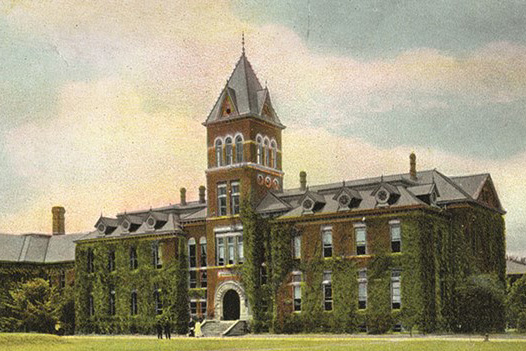
- Civil engineering education at MU began in 1856 with the establishment of the first Chair of Civil Engineering.
- The Department of Civil Engineering was established soon after in 1859.
- In 1871, the School of Engineering was established at MU.
- In 1907, the College of Engineering was officially separated from the College of Agriculture.
- Also in 1907, Ada Wilson, BSC, became the first woman engineering graduate at MU.
- The Civil Engineering baccalaureate program was first accredited by ABET in 1936.
Formally became The Department of Civil and Environmental Engineering in 1998.
About
The Department of Civil and Environmental Engineering is one of 9 academic departments within the College of Engineering at the University of Missouri in Columbia, Missouri.
Undergraduate and Graduate Degrees:
- Bachelor of Science in Civil Engineering (BS CiE)
- Master of Science in Civil Engineering
- Doctoral Degree in Civil Engineering
If you are interested in our program, and have more questions, please contact us.
Student Competition Teams and Clubs
Teams and clubs give students opportunities to challenge themselves in real world environments.
- American Society of Civil Engineers
- Concrete Canoe Team
- Steel Bridge Team
- Timber Bridge Team
- Chi Epsilon - Honors Society
What do civil and environmental engineers do?
Civil engineers design and supervise the construction of roads, buildings, airports, tunnels, dams, bridges, and water supply and sewage systems. They must consider many factors in the design process, from the construction costs and expected lifetime of a project to government regulations and potential environmental hazards such as earthquakes and hurricanes. Civil engineering, considered one of the oldest engineering disciplines, encompasses many specialties. The major ones are structural, water resources, construction, environmental, transportation, and geotechnical engineering. Many civil engineers hold supervisory or administrative positions, from supervisor of a construction site to city engineer. Others may work in design, construction, research, and teaching.
Environmental engineers develop solutions to environmental problems using the principles of biology and chemistry. They are involved in water and air pollution control, recycling, waste disposal, and public health issues. Environmental engineers conduct hazardous-waste management studies in which they evaluate the significance of the hazard, advise on treatment and containment, and develop regulations to prevent mishaps. They design municipal water supply and industrial wastewater treatment systems. They conduct research on the environmental impact of proposed construction projects, analyze scientific data, and perform quality-control checks. Environmental engineers are concerned with local and worldwide environmental issues. They study and attempt to minimize the effects of acid rain, global warming, automobile emissions, and ozone depletion. They may also be involved in the protection of wildlife. Many environmental engineers work as consultants, helping their clients to comply with regulations, to prevent environmental damage, and to clean up hazardous sites.
Bureau of Labor Statistics, U.S. Department of Labor, Occupational Outlook Handbook, 2008-09 Edition, Engineers, on the Internet at http://www.bls.gov/oco/ocos027.htm (visited June 17, 2008).
Research
Our faculty members teach and research alongside graduate and undergraduate students in the following research specialties:
- Environmental & Hydraulic Engineering
- Geotechnical & Geoenvironmental Engineering
- Structural Engineering
- Traffic & Transportation Engineering