March 30, 2026
Mizzou teams dominate the field at the National Medical Device Make-A-Thon, engineering solutions to address issues in neonatal intensive care.
The reputation of Mizzou Engineering — its past success, present growth and future vision — make the college the go-to for high-achieving students who want to accomplish their greatest aspirations.
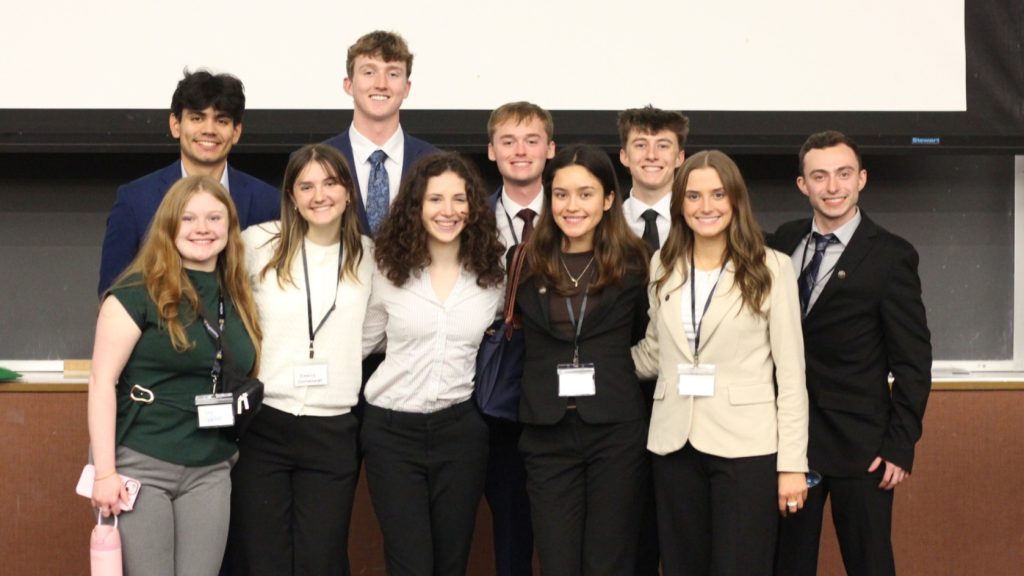
That reputation recently got a boost as Mizzou Engineering undergrads swept the competition at the National Medical Device Make-A-Thon March 6-8 in Austin, Texas.
Student organization IMPACT (Initiative for Medical Prototyping and Applied Concept Translation) sent two teams to the competition, where they joined students from 11 other universities to conceptualize, design and showcase solutions to a real-world topic — this year, a clinical problem faced by premature infants in neonatal intensive care.
IMPACT’s Black team of Andy Brown, Riley Dycus, Emmie Hachenberger, Delaney Rapp and Koen Straubtook first place in the preliminary and final rounds and was voted No. 1 by a panel of industry experts.
The Black team zeroed in on a common problem in neonatal intensive care (NICU).
“The current temperature monitoring probes used in NICUs are held in place with medical tape, which creates a real risk of sensor detachment going undetected by nursing staff,” Straub said. “This problem can lead to incubator temperatures to rise and thus causing hyperthermia within the babies. We set out to design a smarter, gentler solution.”
The Black team designed a sensor patch around a biomaterial hydrogel that adheres gently to delicate neonatal skin. The device, which the team calls ProxiPatch, also features a capacitive proximity sensor that monitors skin contact and a magnetic quick-release connector that allows nurses to disconnect the device without disturbing the infant.
The Gold team of IMPACT president Diego Ochoa, Ashlyn Ohlms, Lily Walker, Michaela Duran and Josh Moore designed a continuous positive airway pressure (CPAP) attachment.
“Our device transfers the pressure from the seal from the baby’s face to the inner nostril through an inflation system using a cannula,” Ochoa said. “This will help prevent long-term and potentially permanent scarring on babies’ faces.”
The Black team will receive mentorship through the Austin Technology Incubator as well as $800 in funding to continue development.
Both teams are now working to refine their devices and will present them to faculty advisors, club sponsors and students at an event later this spring. Students will have further opportunities to work on developing both projects.
Ochoa said both projects were great outcomes for IMPACT, which was started less than a year ago with the intention to prepare students for the competition and help them continue developing their designs afterwards.
“Mizzou students are capable of identifying real clinical problems and developing meaningful engineering solutions,” he said. “Our results reflect the culture of innovation and collaboration that Mizzou Engineering faculty and programs encourage.”
Nearly 50 student organizations thrive at Mizzou Engineering. Explore them all!