January 04, 2026
For their capstone project, computer science students developed an app that leverages LLMs to create targeted experiences for intermediate-level language learners.
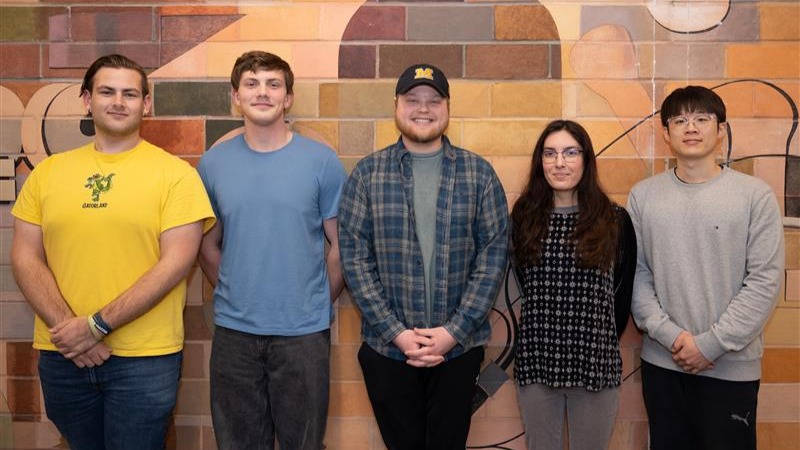
Mizzou Engineering invests in hands-on learning experiences. Senior capstone projects are just one way we prepare students for their future careers and advance solutions to real-world issues. These group projects encourage innovation, creative problem solving and collaboration.
Here’s how a team of computer science students developed an app that leverages artificial intelligence to create targeted experiences for intermediate-level language learners.
Team
Angela Amaro, Seth Ek, Seth Keenan, Seohyun Kim, Kody McNamara, Evelyn Wilbur
Challenge
A lot of language learning software takes users from the basics to more advanced vocabulary along a set path. There are also plenty of native materials for advanced learners. But for intermediate learners, native content is too complex and traditional language learning options are too slow or restrictive. We wanted to fill this gap.
Process
In January 2025, we began brainstorming and settled on a language learning app. We defined our hardware, functional and non-functional requirements and developed our solution.
For our tech stack, we chose Google Gemini for our large language model (LLM), Next.js to build our web application, Supabase to handle our data storage needs and user authentication, and Vercel to host the application.
We chose an iterative agile approach to development, meeting frequently over the summer and taking on stories as we went.
Eventually, our core features were implemented, and we started polishing the project and preparing for presentations.
Results
Our app, Fluentures, leverages LLMs to support intermediate-to-advanced learners with natural, context-rich examples of how native speakers actually use the language. It’s a customizable, gamified app where learners can build their own vocabulary “oases,” with AI-generated stories, sentences and practice activities focused on precisely what they want to study.
Lessons learned
We learned how to integrate and position 3D models within a web environment, something we had never done before. Using React Three Fiber and Blender, we figured out how to render 3D assets interactively inside our Fluentures map.
Some of us learned how to effectively utilize LLMs to generate dynamic learning content. We experimented with using AI to create sentences, quizzes and examples tailored to each user’s custom vocabulary.
We also gained a lot of experience with merging branches, debugging issues between frontend and backend systems, and ensuring that every feature worked together smoothly. This taught us how design, programming and problem-solving come together in building a functional, creative tool.
Preparation
Although the computer science path does not directly require the use of all the technologies we utilized, our experiences taught us to adapt and learn quickly, to use different tools to achieve our goals, and to collaborate effectively.
Approaching this project after taking many of the fundamental courses allowed us to follow a design structure, abide by a common workflow and accurately test our components and application.
Conclusion
There are rising concerns about the potentially negative impacts of AI, including the energy needed to run AI models, as well as LLMs’ effect on human development. By using LLMs for natural language learning, we hope to make efficient use of their strengths and provide a structured environment that encourages deeper, targeted learning.