February 01, 2026
An interdisciplinary team is blazing a trail to the efficient and effective production of compounds essential to common drugs.
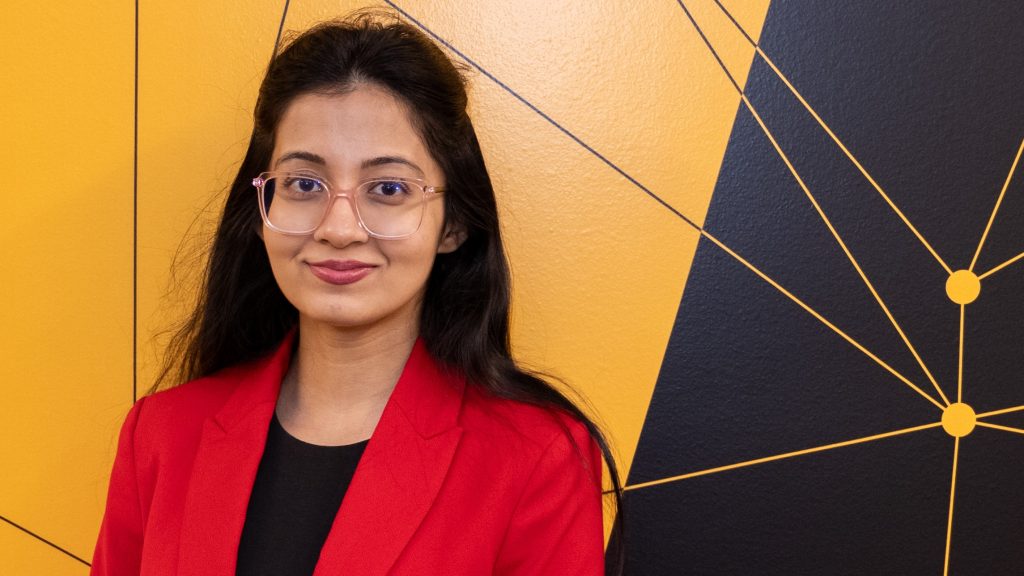
Every day, Mizzou Engineering researchers tackle real-world challenges head-on, combining vision, collaboration and advanced technology to help wet-lab researchers optimize processes and create sustainable solutions with global impact.
An interdisciplinary team of Mizzou researchers has developed a tool to help chemists predict and improve chemical reactions, making drug production and other chemical processes safer, faster and more sustainable. Their research is published in ACS Catalysis.
“We found a way to use artificial intelligence to optimize reactions faster and more sustainably,” said Upasana Roy, one of three lead authors on the study. “We’re not replacing chemists. We’re augmenting their intuition with data-driven guidance.”
About a quarter of Food and Drug Administration-approved drugs contain an amide functional group. Although amides occur naturally, producing them artificially allows us to create customized, potent and safe synthetic routes to acetaminophen, lidocaine and many other everyday drugs.
The conventional method for producing amides relies on organic solvents, which are often toxic, and produces large volumes of chemical waste, disposal of which is highly regulated by strict federal rules that protect the environment but add cost and complexity.
Because these challenges are magnified in pharmaceutical manufacturing, where reactions must scale from milligrams to kilograms without compromising safety or yield, scientists have long sought to optimize conditions to ensure efficiency and cost-effectiveness.
Seeking sustainable solutions
That quest has itself required immense amounts of time, labor and expertise. So Sachin Handa, associate professor of chemistry in the College of Arts and Science, and his team members Karanjeet Kaur and Ramesh Choudhary, had an insight: If artificial intelligence (AI) could predict reaction yields, chemists could prioritize the most promising experiments and avoid waste.
Handa shared his idea with Curators’ Distinguished Professor Prasad Calyam, who introduced him to Upasana Roy, a graduate research assistant specializing in data analysis, machine learning and predictive analytics. Calyam is Roy’s PhD advisor and is supervising her research.
“A key challenge in making predictions to prioritize experiments is ensuring that data collection strategies for model development adequately capture patterns arising from real physical effects,” Calyam said. “It was therefore important to build a predictive model that reflects researchers’ experimental preferences — such as cost considerations, safety constraints and data fidelity — while ultimately supporting the broader goals of scientific discovery.”
“Traditional optimization often means 12-hour reactions with uncertain payoffs,” Roy said. “A predictive model could help eliminate weak ideas early and focus on the most viable, resource-efficient directions.”
Handa, a pioneer in sustainable chemistry, was particularly interested in green alternatives to conventional amide synthesis. One such method is micellar catalysis, which uses tiny soap-like structures to enable reactions in water instead of — and often better than — harmful solvents.
“Micellar catalysis is environmentally significant, but its broader adoption depends on better predictive tools,” Roy said. “That’s where AI can make a meaningful difference.”

But micellar catalysis is a complex and relatively new approach. Because so little is known about what combination of factors is optimal, Roy used representation learning to extract useful relationships from a small dataset and borrowed patterns from conventional solvent reactions.
Micellar catalysis relies on PS-750-M, a molecule that forms micelles in water but otherwise behaves similarly to organic solvents. The data from previously reported methods was collected by the chemistry team on traditional solvents as well as on limited micellar systems, and Roy trained an AI model to predict yields for micellar reactions.
The model, which Roy called Representation Learning for Predicting Amide Coupling Transformations (REPACT), proved highly accurate. The model was tested by Kaur, Choudhary and Jagdeep Virdi in the lab on drug-like molecules to validate accurate yield prediction. When compared to actual lab results, the yields REPACT predicted were usually within 2-10% of the real yields.
“For a low-data model, that’s pretty cool,” Roy said. “Sophisticated results don’t always require overly complex models.”
Impact and next steps
With further validation and expanded datasets, REPACT has strong potential for near-term use in pharmaceutical research environments focused on green and cost-effective synthesis.
“The model doesn’t know chemistry, it just learns patterns,” Roy said. “I want to teach it chemical logic, like why acid and base give salt and water. That will make predictions even better.”
REPACT is highly accurate, computationally efficient and works well even when data is limited, making it practical for real-world adoption. One of Roy’s collaborators was Novartis Pharma researcher Dr. Fabrice Gallou, whose industry perspective strengthened this translational impact.
“Novartis’ involvement helped ensure that our model wasn’t just academically interesting but also aligned with how pharmaceutical companies think,” Roy said.
Other partners on the study include Timothy E. Glass and Justin R. Walensky of the Department of Chemistry in the College of Arts and Science and Suchithra Rajendran and Bahare Askarian of the Department of Industrial and Systems Engineering.
The study highlights how Mizzou encourages cross-departmental research, industry partnerships and innovative thinking — conditions that are essential for tackling complex problems at the intersection of AI and chemistry.
“It was a truly interdisciplinary effort,” Roy said. “That diversity of expertise is what allowed the project to succeed.”Discover more ways Mizzou Engineering researchers are unlocking solutions to real-world problems.