June 17, 2026
Engineering researchers address unpredictable environments with a system designed to coordinate human workers, autonomous mobile robots and operational workflows.
In warehouses and manufacturing facilities across the country, companies are increasingly deploying robots to work alongside human operators. At Mizzou Engineering, researchers are developing decision-support tools to make that collaboration more efficient, safe and scalable.
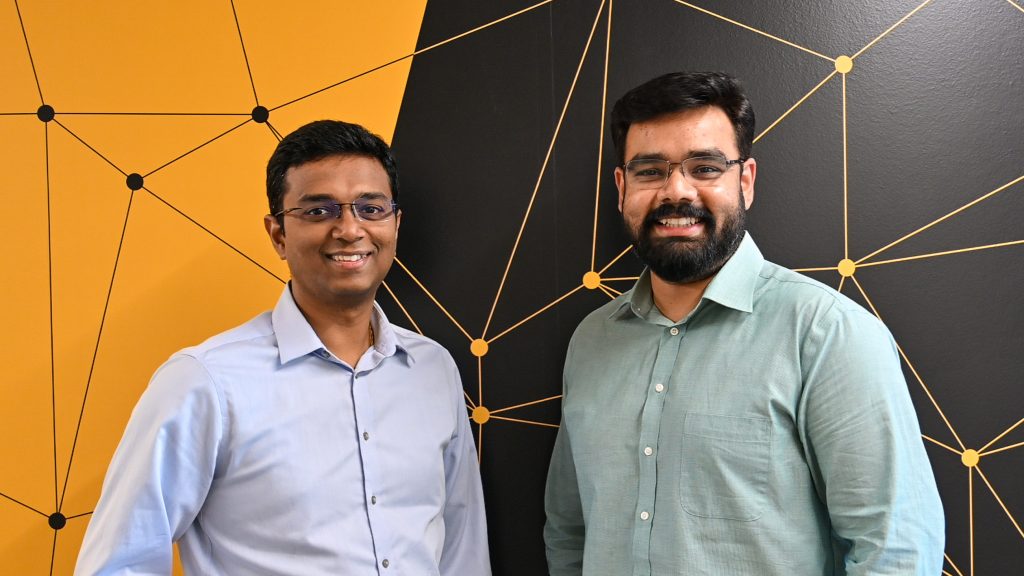
With $50,000 in funding through the National Science Foundation (NSF) I-Corps program, Associate Professor Sharan Srinivas and PhD candidate Arghadeep Mitra are advancing a warehouse execution system designed to optimize how people, autonomous mobile robots (AMRs) and warehouse tasks are coordinated.
To complement the team’s technical research, Mitra conducted more than 125 customer discovery interviews with industry stakeholders, from warehouse managers and logistics coordinators to robotics companies and software developers.
Those conversations revealed a consistent set of challenges in today’s warehouse and fulfillment operations. Many companies still rely on spreadsheets or rule-of-thumb approaches to determine robot fleet size, which can result in systems that are either overbuilt or under-resourced.
Workforce concerns about disruption, role changes and process uncertainty can slow the adoption of new technologies. Labor shortages, high upfront costs and pressure to demonstrate rapid returns on investment compound the issue.
A central challenge is that real-world warehouse environments remain highly variable. Congested warehouse floors, temporary obstacles and dynamic human movement can disrupt robotic coordination, which can lead to delays or operational stoppages.
Mitra and Srinivas are tackling these challenges through Cobot iCommander, a warehouse execution system that uses optimization and AI-enabled decision support to orchestrate collaborative human-robot operations in real time. The system integrates multiple execution-level decisions that are often handled separately, including fleet sizing, order batching, task assignment, sequencing, routing and disruption response.
A key innovation is real-time AMR orchestration, which coordinates human workers, mobile robots and material handling tasks as warehouse conditions change. Cobot iCommander supports execution-level decisions such as task assignment, sequencing, routing and disruption response, while providing managers with decision support for robot fleet planning and operational tradeoffs.

“What makes our approach unique is that we’re not just optimizing one piece of the puzzle,” Mitra said. “We’re jointly optimizing the entire system — robots, humans and workflows — while accounting for real-world uncertainty.”
The potential impact extends across warehouse and fulfillment operations. Faster, more adaptive operations could help sectors such as retail, healthcare logistics and advanced manufacturing meet demand fluctuations while responding more effectively to labor constraints and operational disruptions.
Cobot iCommander could also lower barriers to adoption for mid-sized businesses that may lack the resources to evaluate, deploy and coordinate robotic systems effectively.
The project also points toward the future of intelligent logistics systems. Mitra envisions the rise of agent-based AI, in which different systems manage distinct parts of warehouse operations — such as picking, storing and packing — while communicating seamlessly with one another. Such systems could enable fully coordinated, end-to-end optimization of supply chain workflows.
As automation becomes more common in logistics and manufacturing, engineers need both technical expertise and a clear understanding of operational constraints. Projects like this one show how Mizzou Engineering is not only preparing students to meet that demand but actively shaping a future where humans and intelligent machines collaborate to build stronger, more resilient systems.
“This is about more than building algorithms,” Mitra said. “It’s about developing tools that work in real operating environments and support better decisions.”
Want to conduct graduate research alongside world-class faculty? Join Mizzou Engineering!