May 18, 2026
Civil engineering students built an integrated plan to renovate a medical research building that emphasized safety cost efficiency.
Mizzou Engineering’s senior capstone courses encourage hands-on learning and collaboration to prepare students for upcoming careers. These projects allow students to use innovation and creativity as they tackle real-world problems.
This semester, a team of civil engineers advised how best to renovate a medical science building so it could support modern research, while emphasizing safety, cost and timeline.
Team
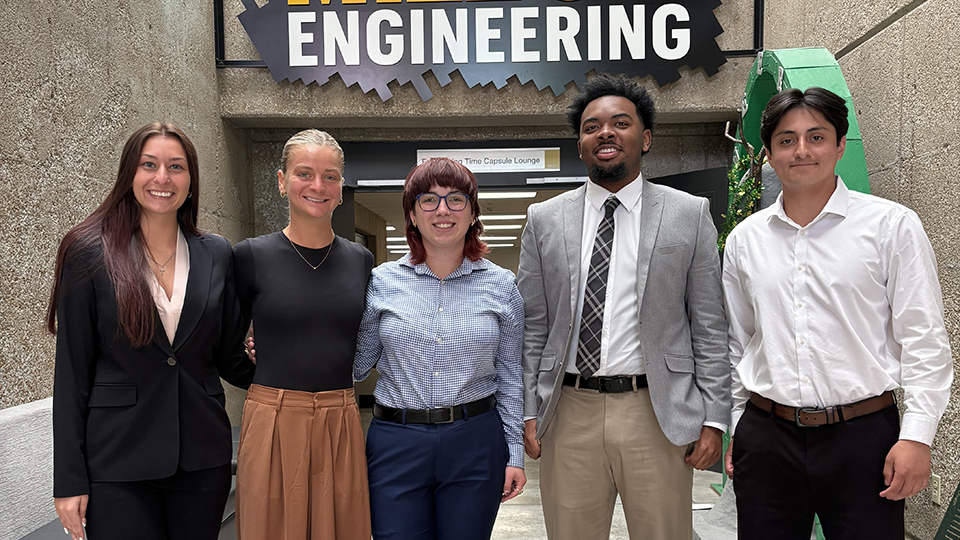
Nick La Chance, Korey Long, Macie McPheeters, Clare Tyson and Emily Van Dover
Challenge
Our group set out to solve how to plan and document the renovation of the 7E level of the Medical Science Building so it can support modern research needs while occupied. The core problem was delivering a constructible, safe and cost‑effective plan. We needed to cover scope, cost, schedule, risk and logistics within a $3.34 million budget and a 323-day duration in an active medical research environment.
Process
We approached the project as MENCK Construction, responding to a competitive lump‑sum bid. We started with a full review of the drawings, specifications and addenda to clearly define the scope.
The team completed detailed quantity takeoffs in Bluebeam for all trades and transferred the quantities into an Excel estimate organized by division, applying unit pricing and leveraging self‑perform capabilities in framing, drywall and ceilings. In parallel, we developed a logic‑based construction schedule that identified activity durations, sequencing and the critical path.
We then overlaid risks, safety controls and logistics constraints such as access, material flow and mechanical, electrical and plumbing shutdown windows. We documented all of this in a final report with technical narratives, appendices for takeoffs and estimate sheets, and supporting schedule and risk/safety materials.
Results
The final deliverables included a complete, documented cost estimate, a fully developed construction schedule, a project‑specific safety and risk assessment, and a detailed site logistics plan tailored to an occupied medical research building.
Our work produced an integrated plan that fit within the owner’s budget and contractual duration while coordinating phasing, shutdowns and lab adjacency to maintain life safety and minimize disruption to ongoing research. The report and appendices provide enough detail for a client or contractor to understand the assumptions, see the breakdown of costs by division and visualize how the project would be executed from mobilization to substantial completion.
Lessons learned
We learned how tightly estimating, scheduling, safety and logistics are linked and how a change in one area can ripple through the others. The project reinforced practical skills in quantity takeoff, cost modeling and schedule development. It also emphasized higher‑level planning — like phasing, risk mitigation and coordination in an occupied facility — that you do not fully grasp in isolated coursework. We also gained experience dividing roles across a project team while still collaborating on shared tasks and saw how tracking hours and effort connect directly to general conditions and project management costs.
Conclusion
This capstone felt very close to real general contracting work because we had to integrate technical accuracy with constructability, risk and communication to the client. It also highlighted how important clear documentation, assumptions and rationale are, especially when another party needs to trust your numbers and your plan without being part of your internal process.
Discover more Mizzou Engineering capstone projects!