December 03, 2025
Researchers are using satellite data and AI to produce a granular inventory of greenhouse gas emissions sources around the world.
At Mizzou Engineering, we have a rich history of pioneering breakthroughs. Our researchers are global leaders at the forefront of discovery and innovation in their fields.
Jordan Malof, an assistant professor in the Department of Electrical Engineering and Computer Science, is developing novel artificial intelligence (AI) methods to integrate complex multimodal data sources to estimate greenhouse gas emissions (GHG) in communities around the world.
The result is a growing and highly granular inventory of emissions sources and pollution estimates for the entire globe that governments, companies and others seeking to reduce GHG can use to make high-impact choices.
The inventory is the work of Climate TRACE, a non-profit coalition of more than 100 nonprofits, tech companies, universities, researchers, and climate experts, each of which brings its own unique expertise to a particular sector. Malof is collaborating with researchers in the Energy Data Analytics Lab at Duke University, where he worked for many years.
“Our focus on buildings grew from earlier work on building segmentation in satellite imagery — developing algorithms to identify buildings and their dimensions automatically,” he said. “That expertise made us a natural fit for estimating building-related emissions.”
Malof and his colleagues have developed one of the highest-resolution datasets of emissions to date — 1 square kilometer granularity — using satellite imagery of the entire populated world. Older datasets often had only a handful of data points for an entire city.
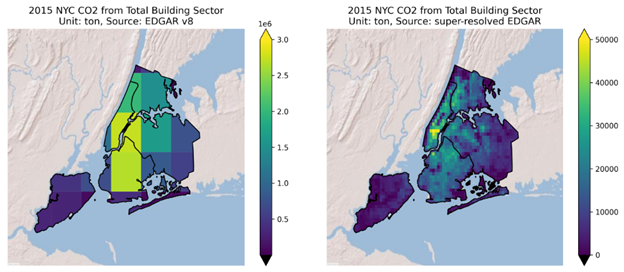
The team applied machine learning to the imagery to estimate building sizes and types and combined this information with data from the European Commission’s Emissions Database for Global Atmospheric Research (EDGAR) to refine emissions estimates. They will incorporate seasonal energy use patterns to track how those estimates change over time.
Since the release of its new emissions reduction tool, decision makers who visit the Climate TRACE website can now click on any facility or emitting source and see GHG reduction strategies at the individual asset level.
“We’re going from a one-size-fits-all approach to granular, targeted interventions,” Malof said.
Such actionable data will enable policymakers and individuals to identify tailored interventions, such as retrofitting buildings for better energy efficiency.
Outside the purview of Climate TRACE’s work, similar techniques could be adapted by other experts to tackle other global challenges, such as tracking population growth, electrification in developing countries, water resources or crop yields.
“We’re developing novel AI and computer vision methods to draw insights about emitting activities at scale,” Malof said. “It’s an example of how AI and big data can be used to make really positive societal impact.”
Discover more ways Mizzou Engineering researchers are unlocking solutions to real-world problems.