February 09, 2026
Doctors and medical students could one day train on models that look and feel like the real thing, giving them more chances to practice safely before working with patients.

By Eric Stann | Show Me Mizzou
Photos by Abbie Lankitus
University of Missouri researchers are developing new ways to better simulate the complex nature of human brain tissue.
For years, scientists have worked to uncover how the brain responds to mechanical forces and electromagnetic waves. Computer models offer useful simulations, but they don’t fully capture what goes on inside a living brain. Now, the team from Mizzou Engineering is working to close that gap by developing 3D-printed models of an artificial human brain.
Novel to their approach, these 3D-models not only look and feel like real tissue but also behave like it, opening the door to safer training, more precise research and advances in personalized medicine. Researchers have already printed a small-scale model, about 15% of the brain’s actual size, and are working toward creating a full-sized version within the next year.
Traditional methods for creating these soft tissue models often result in a reproduction that’s uniform in structure — making it challenging to replicate the variation in stiffness and texture of real human organs. To overcome this challenge, Mizzou’s scientists are using a technique called embedded 3D printing.
Unlike conventional 3D printing, which builds each layer in open air, this approach relies on a jelly-like support bath to hold the soft material in place while it’s being printed. This process provides the needed stability to replicate the brain’s different stiffnesses, as well as print its soft folds and grooves.
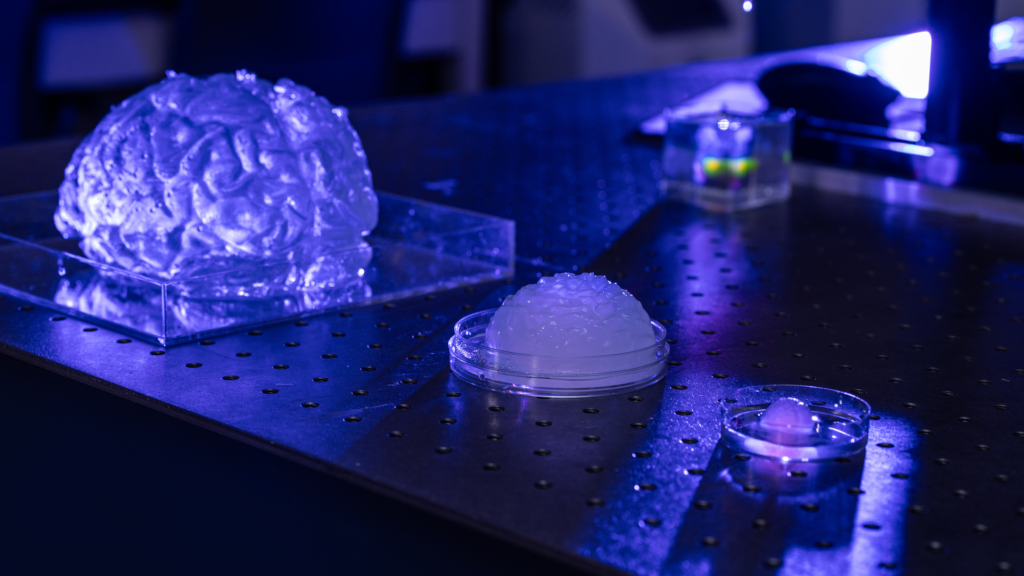
Central to the process is a custom liquid ink — a modified version of a common polymer that researchers can fine-tune to mimic the mechanical, thermal and dielectric behavior of brain tissue, said Christopher O’Bryan, an assistant professor of mechanical and aerospace engineering and co-author of the study.
By carefully adjusting the chemistry, researchers can print regions of the brain that behave like gray or white matter, producing models that are realistic to the touch and scientifically accurate.
“Human tissues are incredibly heterogeneous, made of different materials with different properties,” O’Bryan said. “Our 3D printing approach lets us capture that complexity in a way that wasn’t possible before.”
Real world applications
The potential impact of this technology is wide-ranging.
Doctors and medical students could one day train on 3D-printed brain models that look and feel like the real thing, giving them more chances to practice safely before working with patients.
Using the results of a patient’s MRI or CT scans, researchers could print custom brain models to help doctors plan and personalize treatment. These models could also be used to study how conditions such as Alzheimer’s, brain aneurysms or traumatic brain injuries develop.
Engineers could even use these models to observe how medical implants or everyday electronic devices interact with brain tissue, helping make research more accurate and reliable.
“This is about giving the medical and scientific communities a tool that’s both realistic and personalized,” Mujtaba Rafique Ghoto, a doctoral student and lead researcher on the study, said. “The possibilities for improving health and safety are enormous.”
The study, “3D-printing soft tissue phantom models from photo-crosslinkable poly(vinyl alcohol) methacrylate,” was published in the journal Materialia. Co-authors are Brett Ulery, B. Hayden Daubert and August J. Hemmerla at Mizzou; Deborah ParraCervantes and Stephan Young at the University of Missouri-Kansas City; W. David Hairston and Christopher G. Sinks at the U.S. Army Research Laboratory.
This story originally appeared on Show Me Mizzou. Want more stories like this? Subscribe to the Show Me Mizzou newsletter.