January 04, 2026
Biological and biomedical engineering students collaborated with the College of Veterinary Medicine to build an accurate, realistic and practical model of a feline skull.
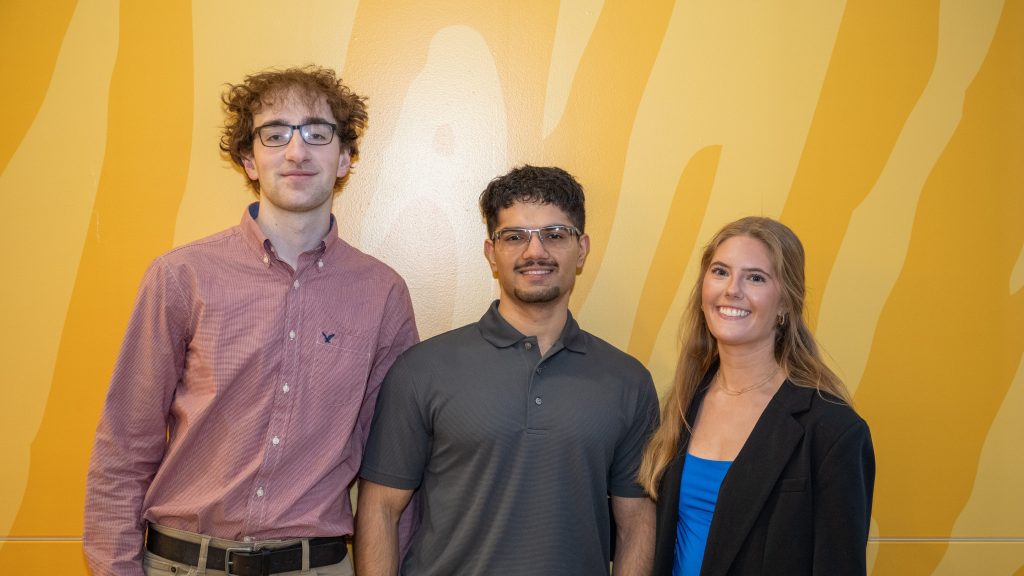
Mizzou Engineering invests in hands-on learning experiences. Senior capstone projects are just one way we prepare students for their future careers and advance solutions to real-world issues. These group projects encourage innovation, creative problem solving and collaboration.
Here’s how a team of biological and biomedical engineering students designed a radio-accurate feline skull model.
Team
Dylan Filby, Piyush Poudel, Carly Torbit
Challenge
Current feline skull models used by College of Veterinary Medicine students are plastic and do not mimic the feel, look or radiopacity of bone tissue. These limitations affect students’ success in learning feline skull anatomy, analyzing diagnostic imaging and practicing procedures.
We set out to design a biologically accurate feline skull that reached critical radiographic, functional and mechanical parameters. Crucial constraints included realistic teeth socket geometry, waterproof and disinfectable materials, and removable and radiopaque teeth.
Process
We partnered with assistant teaching professors Jessica Thiele and Eva Ulery at Veterinary Medicine to address the needs of a real client. We met with the client and began developing a solution using decision matrices, requirements tables, the black box method, and function and means charts to lead our idea generation.
After scanning a real feline skull, analyzing tooth geometry and researching which materials X-rayed the closest to bone tissue, we began developing a working model.
We stuck close to the forming, storming, norming, performing and adjourning stages to properly organize responsibilities and resolve conflict.
Engineering standards and ethical considerations guided our decision making throughout the project since the skull models will be used in a classroom where safety is critical.
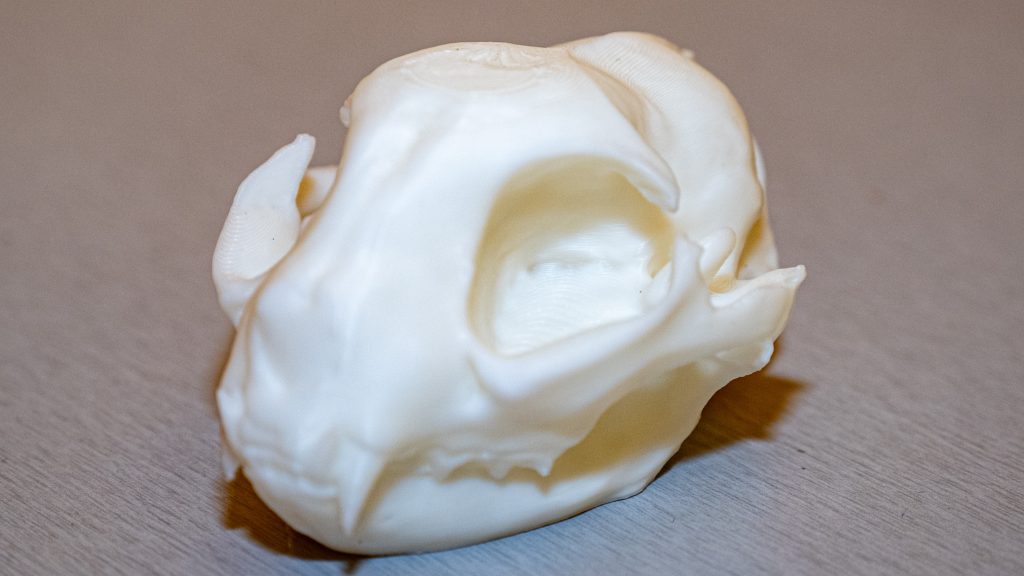
For material, we chose barium sulfate infused polylactic acid (PLA) as the best compromise between affordable costs and radio-accurate scans. The final model is waterproof, disinfectable and safe for students to handle.
Results
Our model closely resembles the geometry, mechanical feel and radiopacity of real bone tissue. The radio-accurate teeth appear clearly on X-rays and can be removed for anatomical accuracy.
Lessons learned
We learned how to apply our engineering education to a single, focused problem. Applying the tools we learned in class to a real-world issue illustrated to us how structured engineering design work turns a vague question into a detailed answer.
We learned the importance of communication and iteration when finding a balance between attainable fabrication and client expectations. Problem solving mindsets, collaboration, ethics, management and materials science were at the core of the project.
Most importantly, we learned that we had the capability to accomplish what we put our minds to.
Preparation
Mizzou Engineering gave us a firm foundation in group work, collaboration and troubleshooting.We had all completed coursework in CAD modeling, anatomy, instrumentation, materials, professional development and more.
Faculty supported us throughout the process, and the capstone lectures’ focus on ethical responsibility, standards and problem solving influenced how we approached this challenge.
Conclusion
Our work will have a direct impact on student learning at Veterinary Medicine. We want to thank Kathryn Darr, DVM, and graduate research assistant Aaron Tran for pushing us and providing a positive learning environment. We also want to thank our clients for helping prepare us to enter the engineering field.