May 17, 2026
Chemical engineering students tackle renewable energy production through anaerobic digestion of cow manure.
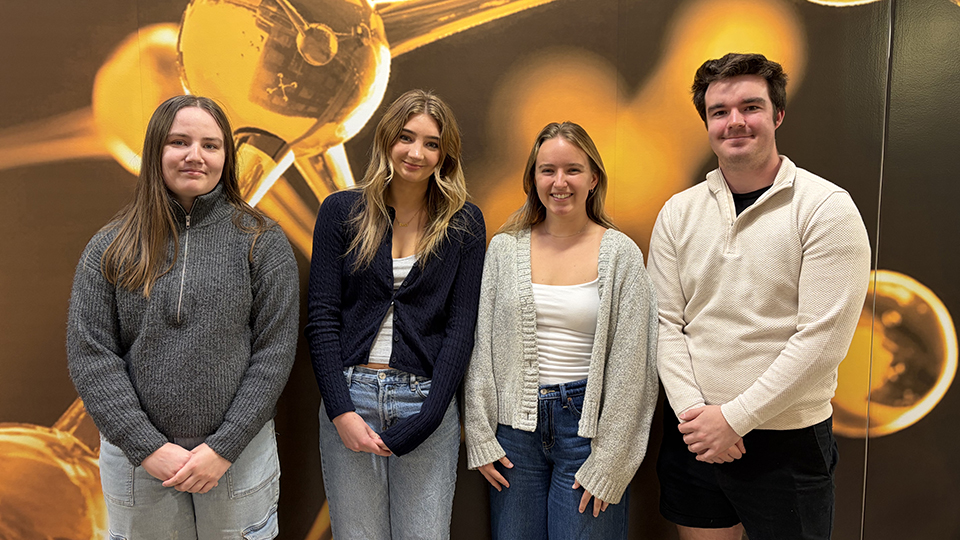
Senior capstone courses at Mizzou Engineering focus on experiential learning and teamwork, helping students build skills for their professional careers. Through these projects, students use creativity and teamwork to solve real-world challenges.
A group of chemical engineering students took on the task of producing renewable natural gas through anaerobic digestion.
Team
Sarah Fox, Chloe Langendorf, TJ Slazyk and Haylii Sondrol
Challenge
Our group was tasked to design an anaerobic digestion process using a cow manure feedstock to produce renewable natural gas (RNG) suitable to be accepted into the local natural gas grid. We were also encouraged to recover the carbon dioxide by-product so that it could be used at an industrial or food and beverage specification.
Process
We started with a simulation of an anaerobic digestor with all of the kinetics input. From there we had to optimize parameters such as temperature, pressure and residence time. The product stream of biogas had impurities, such as hydrogen sulfide, that had to be removed.
Choosing a process to remove hydrogen sulfide was our most challenging task . We started by trying to simulate a biotrickling filter but had to abandon that idea due to the limited simulation capability of Aspen[ST1] [LK2] . We researched a few other technologies before deciding on an absorption column using a water solvent to minimize operating costs.
After the absorption column, a flash vessel was used to remove excess water before the biogas was fed to a pressure swing adsorption system. Aspen did not have a block to simulate this technology, so calculations for these product streams were done by hand. The by-product stream of the anaerobic digestor was the liquid digestate. This stream was separated into solids and liquids to be sent back to the farms providing the manure. Screw presses operating in parallel and a dryer were used in this separation process.
We then had to conduct a process hazard analysis and determine the economic feasibility of our process. The PHA required an in-depth analysis of safety concerns with the process, thinking through all of the what-if scenarios. From here, safety procedures were identified to prevent these potential scenarios from occurring. The economic analysis involved determining operating costs, revenue and a net present value.
Results
The RNG was within the specified standards to be accepted into a local natural gas grid. The carbon dioxide was also able to be recovered and sold at the industrial grade price. Despite our efforts, the process did not provide a sufficient financial incentive for implementation and was not recommended because of the limited revenue in comparison to the costs of manufacturing and running the facility.
Lessons learned
We learned how to implement pieces of equipment and how to design these pieces throughout the process. One of the major systems we had to design was a pressure swing adsorption unit for carbon dioxide removal from methane, which was a very interesting system to learn about. We chose our own adsorbent material and calculated how much we needed and what size the unit would need to be. We also learned about hydrogen sulfide removal through this project, where we designed an absorption column that used water as our solvent for the hydrogen sulfide impurity.
Conclusion
We want to thank Dr. Scott Christensen for his support throughout the process and all our ChemE professors throughout our educational journey!
Discover more Mizzou Engineering capstone projects!