April 21, 2026
The club’s two-stage rocket, Ad Astra, achieved speeds of roughly Mach 1.5 before reaching an apogee of 22,000 feet with a payload of 10 golf balls.
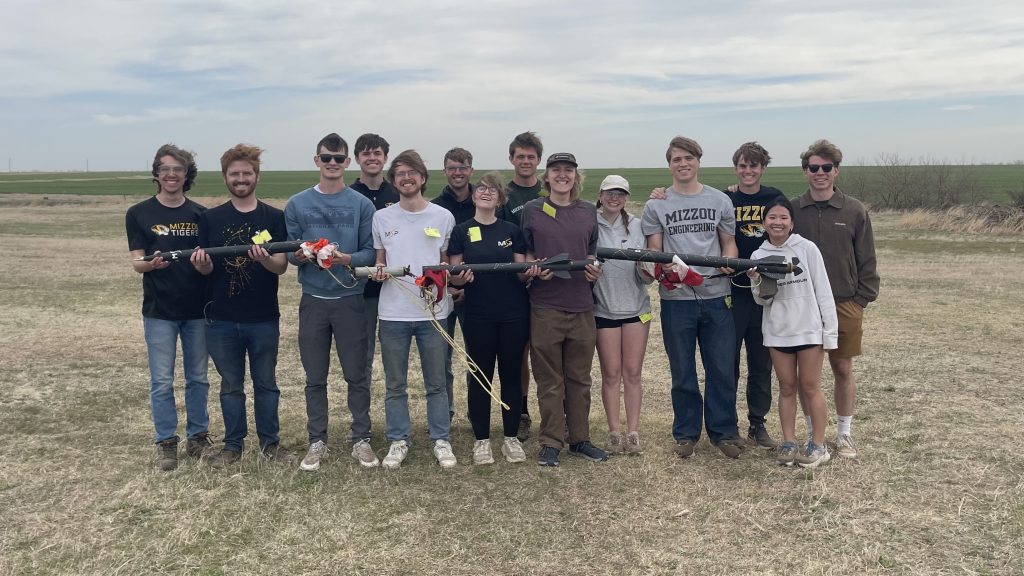
The Mizzou Space Program placed fourth among 21 teams competing at the Argonia Cup Competition March 22 in Argonia, Kansas. The finish marks the first time the student organization placed in the event and their first successful two-stage flight.
The club’s two-stage rocket, Ad Astra, reached an apogee of 22,000 feet. For the competition, the rocket carried 10 golf balls. The minimum‑diameter, high‑power rocket is 109 inches long, has a maximum booster diameter of 2.4 inches, and a liftoff mass of about 15.75 pounds.
Ad Astra uses a K2050 motor in the booster and a K480 motor in the sustainer, providing a combined impulse of 3,657 Newton seconds. The booster’s very short 0.7‑second burn produces an off‑rod velocity of 144 fps to minimize tilt before staging. The sustainer burns for 4.3 seconds.
Maximum flight conditions include a velocity of roughly Mach 1.5 and peak acceleration near 1,000 fps2, with stability margins of 3.09 calibers for the full stack and 2.12 for the sustainer alone.
The Mizzou Space International Rocket Engineering Competition (IREC) also tested their rocket, White Monster, which reached 7,000 feet. The rocket was retrieved and will compete at the 2026 IREC, June 15-20 in Midland, Texas.
The club’s participation in the Argonia Cup was supported by a $14,701 grant from NASA’s Goddard Space Flight Center.
See how far you can go. Become a Mizzou Engineer!