May 18, 2026
Industrial engineering students applied analytics and systems thinking to help MU Health Care optimize providers’ clinic time and deliver better care.
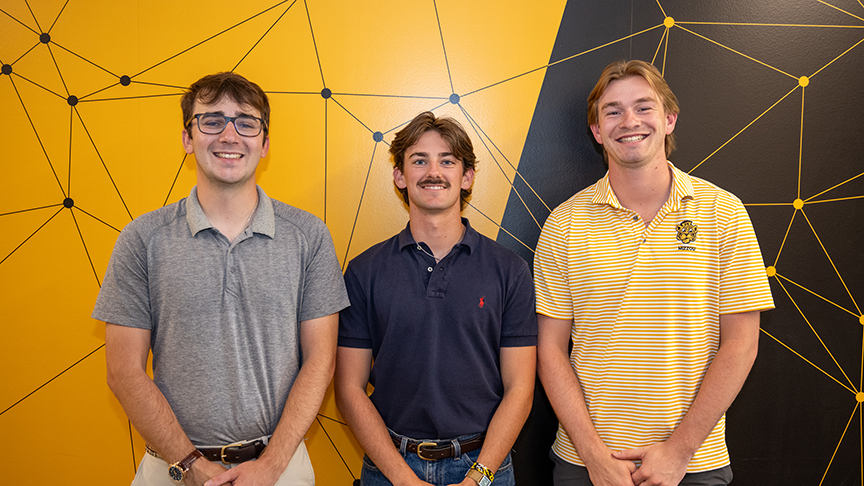
At Mizzou Engineering, hands-on learning is central to the student experience. Senior capstone projects help prepare students for their careers while tackling real-world problems, encouraging innovation, creativity and teamwork.
For their capstone project, a team of industrial engineers worked with MU Health Care to help eliminate wasted clinic time from patients missing appointments.
Team
Louis Dell-Orco, Luke Voelker and Noah Voss
Challenge
Through communication with Dr. Julie Riley, urologist with MU Health Care, we decided that our skills were best used to maximize doctor face-to-face time with patients. From there, we focused on eliminating the clinic time wasted when patients missed appointments.
Process
So much of industrial and systems engineering is following built problem-solving processes. Generally, they all follow the DMAIC pattern: Define, Measure, Analyze, Improve, Control. We defined that we’d like to tackle that doctor downtime created by no-show appointments. We then measured the last five years of historical data. This resulted in a large data file with front-desk characteristics of patients and their resulting show/no-show status.
To analyze, we identified some machine learning models that could find trends in patient behavior, giving us an idea of what kinds of patients miss appointments and hopefully allowing us to predict whether a patient would show up.
Our improvements were two-phase; First, we identified the top combinations of characteristics that led to missed appointments. Parameters like reason for appointment combined with health portal enrollment help to create a picture of a patient worried about their health, or scheduling on a whim and backing out.
Second, our ongoing goal is to create a machine learning model accurate enough to become a scheduling prediction tool. If we can comfortably predict that a patient will miss an appointment, the front-desk staff can make some calls and find a patient to take that predicted opening.
We’re working to control this process by establishing scheduling workflows that increase the patient’s chance of showing up. For instance, if certain times of day work better for particular age groups, let’s get those groups into appointment slots that maximize their chance of attending.
Results
We identified some unique patterns in patient behavior. Patient engagement is a huge factor in whether a patient attends an appointment. We can predict how engaged a patient is by pointing to the severity of their appointment reason and their enrollment in the online health portal. A patient who takes the time to enroll and engage with their health is likely to value their appointment slot.
We can also dispel previously held notions about how patients behave. We hypothesized that number of days to appointment would be a big factor for patient no-shows, but it wasn’t a significant parameter in the analysis. This ability to quantify and test assumptions in health care is great for grounding our collective common sense in real results.
Our full scheduling assistant model is a work in progress. There are ongoing discussions and improvements to be made before it’s ready to be fully implemented into the scheduling workflow. We’re focused on guaranteeing scheduling decisions are made responsibly, with full confidence in any implemented technology to improve the quality of care for every patient. In health care, stakes are much higher than rows in an Excel sheet, and we’re operating with those stakes in mind.
Lessons learned
We learned so much about the health care system and the ongoing efforts of everyone in it to provide exceptional care. Dr. Riley very patiently helped us wrap our heads around the complexity of life in a hospital setting. We also learned just how difficult it is to model the behavior of people. An incredible number of factors go into every decision people make in their daily lives, and capturing just a fragment of those to analyze one event was an amazing challenge.
Conclusion
Many industrial and systems engineering discipline areas came together for this project. It tied four years of education into a neat bow. The systems analysis skills, problem solving frameworks and data modeling tools that we used were drawn from various classroom, student organization and internship opportunities that we experienced through Mizzou Engineering.
We’d like to thank Dr. Riley for allowing us to work in the Urology clinic, Dr. Noble for his mentorship, and all the ISE faculty who have taught us over the years.
Discover more Mizzou Engineering capstone projects!