September 08, 2026
An emerging form of artificial intelligence could give scientists a clearer view of how living systems change over time and accelerate the pace of medical discoveries.
By Eric Stann | Show Me Mizzou
Photo by Abbie Lankitus
University of Missouri researchers are paving the way as artificial intelligence transforms biomedical research.
A team from the College of Engineering and collaborators recently published one of the most comprehensive reviews to date of an emerging AI approach for biology known as flow matching. The work provides scientists around the world with a roadmap for applying the technology to accelerate drug discovery, precision medicine and other biomedical advances.
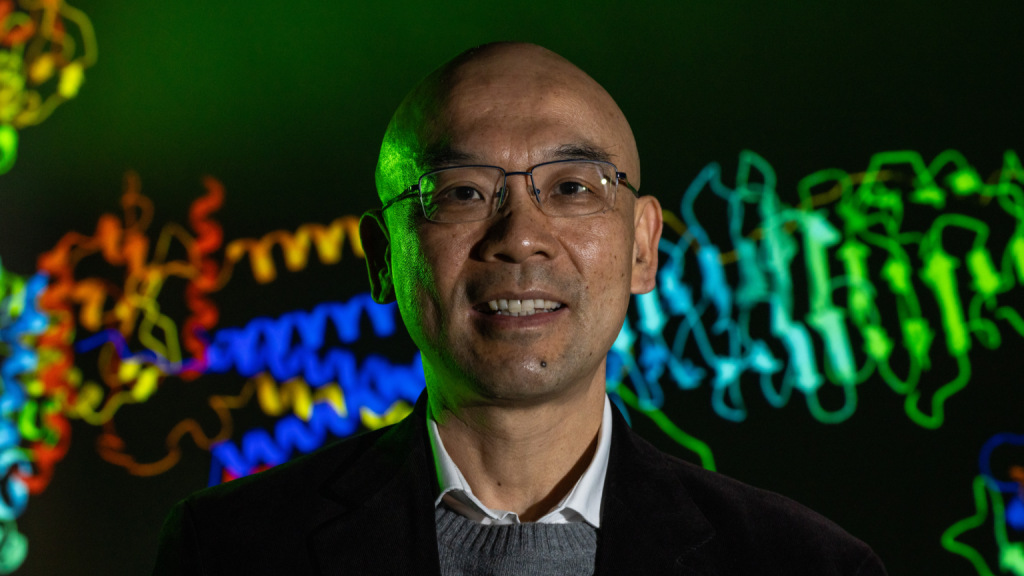
“Flow matching helps computers learn how biology changes from one state to another,” said Jianlin “Jack” Cheng, a Curators’ Distinguished Professor and Paul K. and Diane Shumaker Professor in Bioinformatics. “This gives scientists a powerful new way to study everything from protein folding to cell development and cancer progression.”
Understanding life changes
As biological processes unfold, cells grow, proteins change shape and diseases evolve. Yet many traditional computational tools analyze only individual moments in time. Flow matching allows AI models to learn how those systems move from one state to another, offering researchers a more complete picture of the biological processes that drive health and disease.
Because flow matching can model biological changes at multiple scales, it gives scientists a powerful new way to study some of biology’s most complex questions.
At the molecular level, researchers can use it to predict how proteins fold, a key step in developing new treatments. On the cellular level, flow matching can simulate how cells respond to different conditions. And at larger scales, it can help connect what’s happening inside individual cells to changes across entire tissues.
Together, these capabilities provide scientists with a more unified way to model how living systems function and change over time.
“Computers can see connections across enormous amounts of data that humans simply can’t,” said Cheng, who is also a NextGen Precision Health investigator. “That helps researchers move faster and ask better questions.”
The work also lays the foundation for even more ambitious breakthroughs. One long-term goal is an AI-powered “virtual cell,” a comprehensive digital model that could allow scientists to test ideas on a computer before moving into the laboratory.
“Over time, this could reduce reliance on animal and human studies and accelerate progress toward more personalized medicine,” Cheng said.
As generative AI continues to reshape research, Cheng believes flow matching could be part of a broader shift in how scientists study life itself.
“Flow matching is becoming a unifying framework for generative AI in biology,” he said. “It has the potential to fundamentally change how we model, study and understand living systems.”
The study, “Flow matching for generative modelling in bioinformatics and computational biology,” was published in the journal Nature Machine Intelligence. Co-authors are Akshata Hegde, Yanli Wang, Frimpong Boadu and Joel Selvaraj at Mizzou; Alex Morehead and Aditi Krishnapriyan at Lawrence Berkley National Laboratory; Lazar Atanackovic at University of Alberta; and Alexander Tong at Université de Montréal.
This story originally appeared on Show Me Mizzou. Want more stories like this? Subscribe to the Show Me Mizzou newsletter.