April 19, 2026
Mizzou researchers have created a new way to kill bacteria that gets trapped within surgical implants.
By Brian Consiglio | Show Me Mizzou
Photo by Justin Kelley
If a surgical implant becomes infected, the consequences can be devastating — and traditional antibiotics often fail to fully eliminate the infection. But researchers at the University of Missouri believe a targeted beam of neutrons could hold the key to treating infections that form on implants such as heart stents, pacemakers, defibrillators, or knee and hip replacements.
The Mizzou team is developing a new approach called boron neutron therapy, which directs a beam of neutrons at implants coated with boron, instantly killing the bacteria.
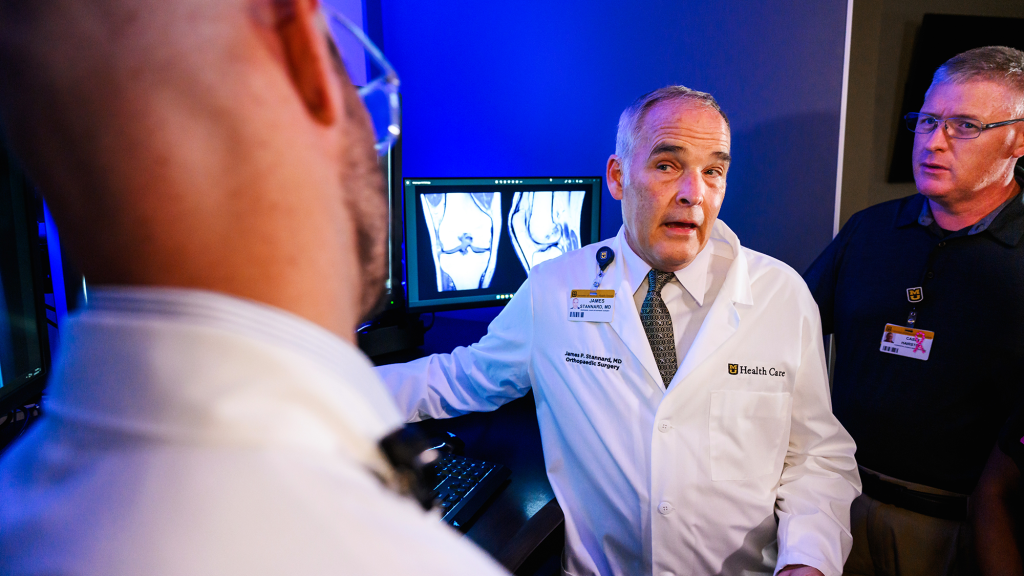
“When surgical implants get infected, the bacteria hides behind a biofilm, preventing antibiotics from working, and as a result, the surgical implant may have to be removed, which is not ideal,” James Stannard, chair of orthopaedic surgery in the School of Medicine and collaborator on the new therapy, said. “We created a way to sterilize an implant so the bacteria are completely killed, which may be a huge clinical step forward.”
Stannard is collaborating on the boron neutron therapy with Mizzou’s John Gahl, a professor in the Department of Electrical Engineering and Computer Science and senior research specialist for the University of Missouri Research Reactor (MURR); John Brockman, an associate professor in the College of Arts and Science and associate director of research and education at MURR; and Charles Maitz, an associate professor in the College of Veterinary Medicine and research scientist at MURR.
A “What if?” moment
Gahl, who came to Mizzou 26 years ago to work at MURR, first had the idea for using boron neutron therapy to treat infections while attending a seminar in the School of Medicine. At the time, surgeons were turning to engineers for solutions to surgical implant infections resistant to traditional antibiotics.

Gahl wondered whether boron neutron therapy — already showing promise in Finland and Japan as a more targeted cancer treatment — could also be used to treat infections in surgical implants.
Gahl and his interdisciplinary team of Mizzou collaborators applied for a patent on the process in 2019 and recently secured the patent after seeing promising results in mouse models.
“Mizzou is a special place where this kind of innovation is possible,” Stannard said. “Having orthopaedic surgeons, engineers, veterinary medicine experts and research reactor experts all on the same team is a game changer.”
While MURR and other research reactors can generate neutron beams, they are not widely available in most U.S. hospitals. The Mizzou team may pursue collaboration with an industry partner to explore boron-coated implants, which could make neutron therapy a practical option if infections arise.
“Ideally, if enough hospitals were to have these neutron beam accelerator machines, patients would not have to leave the hospital to have access to this therapy,” Gahl said. “While there is still a way to go before this becomes a widely available therapy, we are moving in the right direction and are optimistic about the future.”
This story originally appeared on Show Me Mizzou. Want more stories like this? Subscribe to the Show Me Mizzou newsletter.