August 10, 2026
Mizzou Engineering researcher Sharan Srinivas has explored how relief organizations can combine trucks and drones to distribute aid more quickly and efficiently after a disaster.
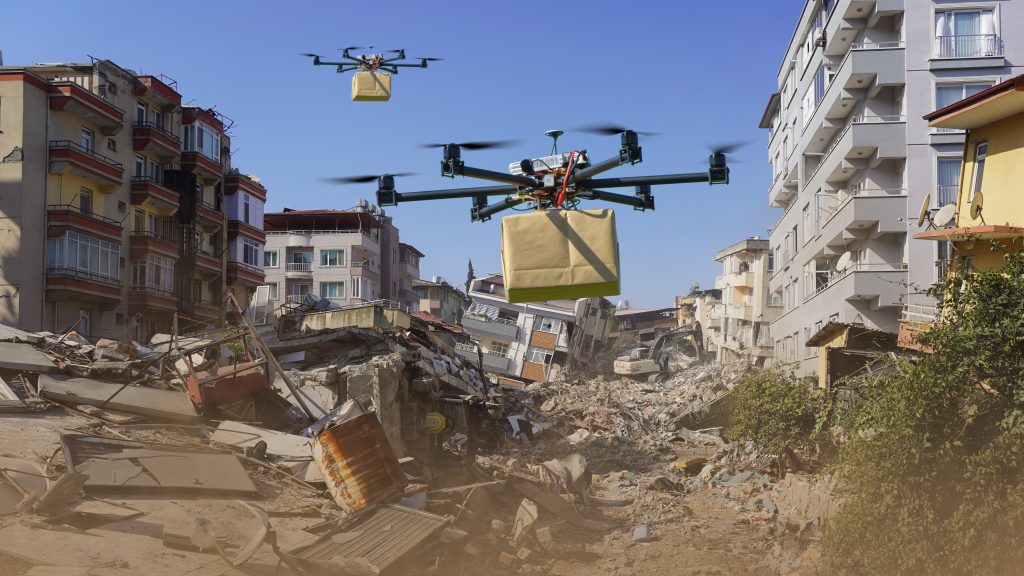
When disasters strike, roads, bridges and other transportation infrastructure are often damaged, making it difficult to deliver food, medicine and other critical supplies. A Mizzou Engineering researcher has led a team to explore how relief organizations can combine trucks and drones to distribute aid more quickly and efficiently after a disaster.
The research team developed a new planning model that determines where to locate temporary distribution centers, how to route trucks, when and where to launch drones, and how to split deliveries among multiple vehicles and drones.
The study found that integrating drones into relief operations can significantly reduce delivery times compared with truck-only systems. Across a wide range of test scenarios, drone-assisted delivery reduced overall relief completion times by between 15% and 42%. The researchers also developed a new solution approach, called Prescriptive Analytics with Clustering and Optimization (PACO), that can efficiently solve large and complex disaster-response planning problems.
Who is conducting the research?

Sharan Srinivas, associate professor in the Department of Industrial and Systems Engineering, is a co-author of the study. Other researchers are Teena Thomas of the T. A. Pai Management Institute Bengaluru and Manipal Academy of Higher Education in India and Chandrasekharan Rajendran of IIT Tirupati and IIT Madras in India.
Together, the researchers bring expertise in operations research, logistics, optimization, supply chain management and analytics, with a particular focus on vehicle routing, drone-assisted logistics and humanitarian operations.
Why is this research important?
Speed is critical in disaster response. Delays in delivering food, water, medical supplies and other necessities can put lives at risk. Traditional truck-based delivery systems may struggle when roads are blocked or damaged. Drones can reach isolated communities more easily, but their limited payload capacity and battery life make them less effective when operating alone.
“Disasters place enormous pressure on logistics systems at exactly the time when roads, access, and delivery capacity are most constrained. In those settings, the speed and reliability of relief delivery can directly affect how quickly critical supplies reach affected communities.” – Sharan Srinivas
This research shows how trucks and drones can work together as a coordinated system. Trucks act as mobile bases that transport supplies and launch drones to serve hard-to-reach locations. By combining the strengths of both technologies, relief agencies can improve access to affected communities, shorten delivery times, and make better use of limited resources.
The study is also important because it addresses several logistics decisions simultaneously, including distribution-center selection, fleet deployment, routing, scheduling and demand allocation. Previous research often examined these decisions separately, but effective disaster response requires these decisions to be considered jointly.
“Our work examines the value of integrating drones with traditional ground vehicles so relief operations can better serve locations with different needs and access conditions.” – Sharan Srinivas
Who benefits from this research?
Humanitarian organizations, emergency management agencies, non-governmental organizations and government disaster-response teams can all benefit from the findings. The model provides a decision-support tool that helps planners determine how best to position resources and deliver aid under challenging conditions.
Communities affected by disasters are the ultimate beneficiaries. Faster and more responsive delivery of relief supplies can reduce suffering and improve outcomes during emergencies. The research also offers guidance for organizations considering investments in drone technology by identifying how drone speed, payload capacity, endurance and fleet size affect performance.
Researchers and logistics practitioners may also benefit from the new optimization techniques developed in the study, which can be adapted for other humanitarian and transportation applications.
“This research highlights the role of industrial and systems engineering in addressing real-world challenges by combining analytics, optimization, and decision-making tools to design more resilient logistics systems.” – Sharan Srinivas
Where is the research published?
The research is published in the International Journal of Production Research, a leading peer-reviewed journal in operations and supply chain management. The article, titled “Integrating drones into post-disaster logistics: a two-echelon location routing model with split deliveries and heterogeneous fleet,” was published online June 11, 2026.
Bottom line
Combining trucks and drones can substantially improve disaster-relief logistics by delivering aid faster, especially in areas where roads are damaged or inaccessible, reducing overall relief-delivery completion time by 15%-42% compared with conventional truck-only systems. The findings provide practical guidance for humanitarian organizations seeking to build faster, more flexible and more resilient disaster-response networks.
What can I study if I’m interested in this research?
Interested Mizzou Engineering students can pursue a bachelor’s degree in industrial engineering or earn a master’s in industrial engineering in as little as one additional year with the accelerated Bachelor of Science in industrial engineering and MS in industrial engineering. Additionally, the dual Bachelor of Science in industrial engineering and Master of Business Administration program allows students to earn an MBA in as little as one additional year.