October 21, 2026
For five years, NextGen Precision Health has been home to a growing interdisciplinary community of researchers collaborating on big challenges.
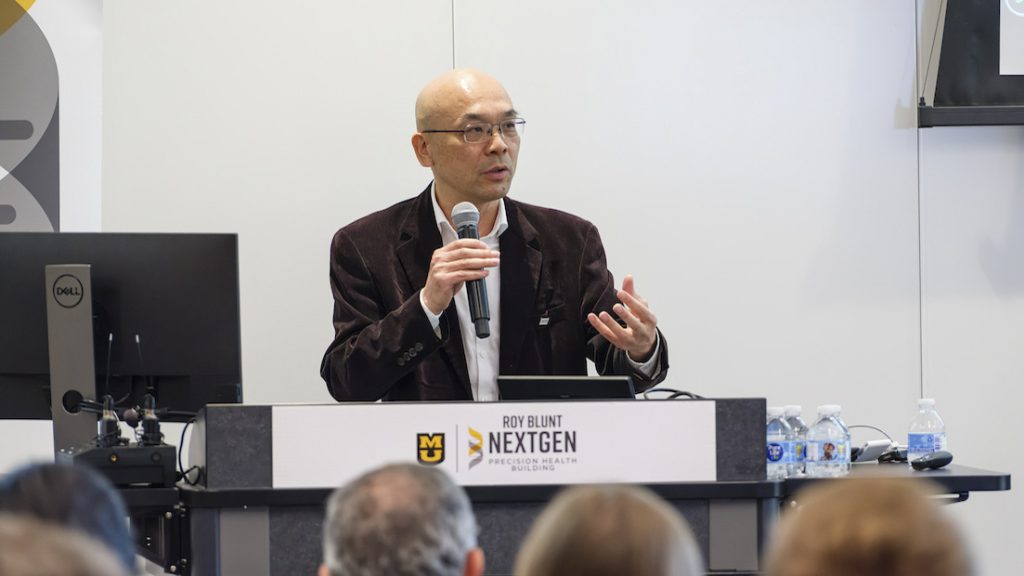
The University of Missouri celebrated the fifth anniversary of the opening of the Roy Blunt NextGen Precision Health Building Oct. 20 with a special edition of its Discovery Series of monthly lectures geared toward a broad multidisciplinary audience.
Speakers told the story of building interdisciplinary teams, growing research capacity, extending impact beyond campus and producing collaborative science that benefits the wider research community.
NextGen is home to 52 lab groups and has been awarded a total of $286.36 million since opening. Since fiscal year 2022, NextGen researchers conducting clinical studies in ALS gene therapy, complex cellular therapy, rare skeletal disorders and other pioneering science have welcomed an average of 240 participants per month.
University of Missouri Vice Chancellor for Research Tom Spencer told an audience in the Atkins Family Seminar Room how NextGen Precision Health built a community of researchers around a common mission.
“This building was purposely designed to bring together people from different disciplines to solve complex health problems,” he said. “We’re not interested in silos. We’re interested in people working together to solve problems.”
To create that community, former NextGen Executive Director Rick Barohn and his team needed to fill gaps in the research expertise and capabilities that existed at the time and assemble a comprehensive precision health enterprise, even as construction of building got underway. “We’ve been really busy over the last six and a half years, and I think by any measure, it’s been extremely, extremely successful,” he said.
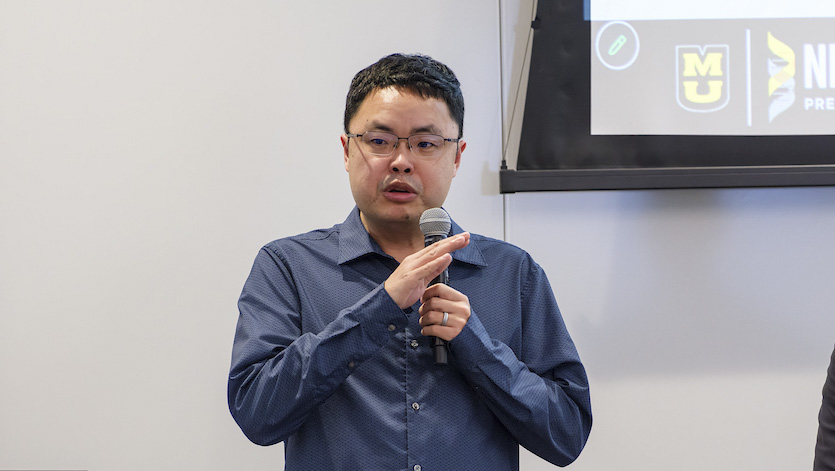
Seven researchers active at NextGen delivered three-minute flash talks, including Curators’ Distinguished Professor Jianlin Cheng of the David L. Payne Department of Electrical Engineering and Computer Science and Associate Professor Zheng Yan of the Department of Chemical and Biomedical Engineering.
Cheng highlighted his research on using advanced artificial intelligence (AI) and deep learning methods to predict protein structures from amino acid sequences, and how his lab has developed open-source computational AI models and software platforms for other researchers to use.
“These tools can help us understand how mutations change proteins, how to use drugs to mitigate the negative impacts of mutations, and advance precision medicine for individuals,” he said.
Yan described his lab’s work on skin-like wearable devices designed for personalized healthcare, with a goal of enabling continuous monitoring and personalized care outside traditional healthcare settings.
“We integrate wearable sensors, artificial intelligence and therapeutic technologies into one platform,” he said. “Our goal is to make healthcare available anytime, anywhere.”
Other researchers delivering three-minute flash talks were David Arnold, Ai-Ling Lin, Haval Shirwan and Wipawee Winuthayanon.
NextGen Precision Health Building Director Scott Rector concluded the flash talks with a high-level perspective on how the initiative transformed research at Mizzou.
“This has always been about bringing people together around big challenges,” he said. “The success of NextGen demonstrates what can happen when researchers are given the resources and environment to collaborate.”
Want to blaze trails in interdisciplinary research? Join our faculty!