April 05, 2026
Mark Hense (BS IE ’85) spoke to the Mizzou Engineering Student Council about the value of an engineering degree and the importance for flexibility and resilience for today’s careers.
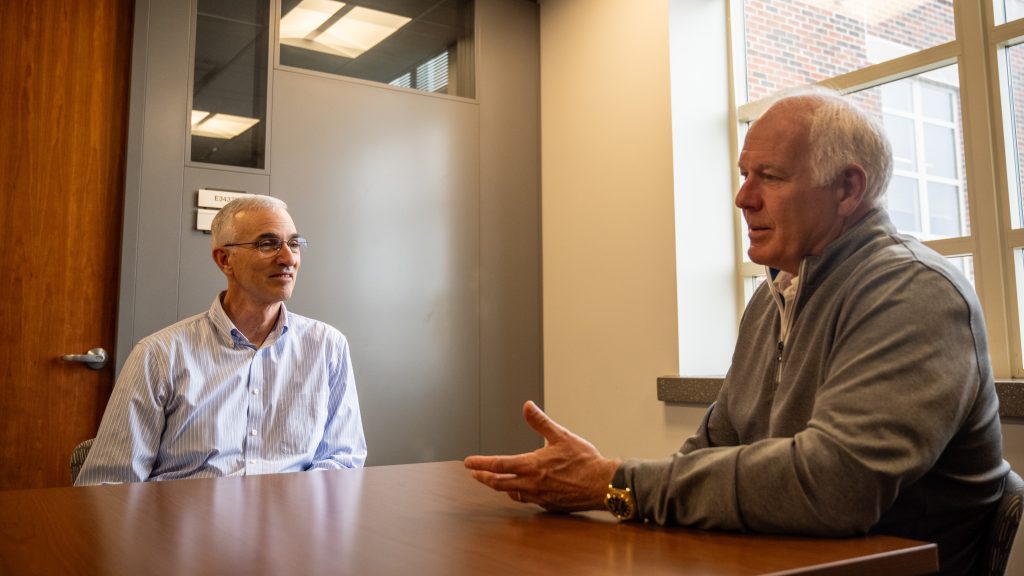
Mizzou Engineering alumnus and ISE Hall of Fame member Mark Hense (BS IE ’85) returned to campus April 1 to speak with the Mizzou Engineering Student Council, sharing a wide-ranging career story and a powerful message about adaptability, risk and the evolving nature of engineering careers.
Hense, was invited by Jim Noble, chair of the Department of Industrial and Systems Engineering, to speak with student leaders about career development and the value of an engineering education.
Hense’s professional journey reflects the realities students are likely to encounter after graduation, Noble said.
“Very few careers follow the plan you create as a student,” he said. “Mark’s experience shows how an engineering foundation can prepare you for change, opportunity and leadership in ways you may not expect.”
Hense’s career spans more than four decades and seven companies, primarily in manufacturing of filtration and specialty materials. He began his professional life at Hallmark Cards in traditional industrial engineering roles before pivoting into global sourcing as a buying agent in Hong Kong. Over time, he transitioned from technical engineering positions into general management and entrepreneurship.
Among his most significant achievements, Hense helped lead major manufacturing restructurings, founded and scaled multiple businesses, and eventually sold a U.S.-based manufacturing company for more than $40 million.
Today he is CEO of Trinity Technical Group, a specialty materials firm producing highly advanced PTFE membranes used in power generation, medical implants, consumer products, clean energy technologies and automotive applications, including components used in Tesla vehicles worldwide.
Hense spoke of the value of an engineering degree and how it can serve as a foundation upon which students can build any number of careers.
“An engineering degree puts you in a rare position,” he said. “It gives you options. You don’t have to follow a straight line, and you shouldn’t expect to.”
Hense encouraged students to think broadly about how they might apply their technical skills, including in business, management and technical sales, areas where engineers can have significant impact. He also spoke candidly about risk and failure.
“You’re going to have interrupters,” he said. “Industries change, companies change and sometimes things don’t work out. That’s not failure — that’s the process.”
Hense urged students to understand their own risk tolerance and comfort zones, particularly if they are considering entrepreneurship or leadership roles. He emphasized that business decisions rarely exist in black and white, a contrast to the certainty engineers often seek in technical problem solving.
For Noble, the event highlighted the importance of alumni engagement in student development.
“This is exactly the kind of perspective students can’t get from textbooks,” he said. “Hearing from alumni like Mark helps them understand that success looks different for everyone, that flexibility is a strength, and that the ability to understand variability that industrial engineers are trained to exploit is key to leading an organization.”
Hense’s visit underscored Mizzou Engineering’s commitment to connecting students with alumni who exemplify lifelong learning, resilience and service — reminding future engineers that their careers are not defined by where they start, but by how they grow.