March 31, 2026
A new study demonstrates how disinfectants oxidize plastic pipes over time, influencing how they accumulate heavy metal particles in water.
At Mizzou Engineering, we’re driven by curiosity, constantly questioning what’s known and advancing possibilities in every engineering discipline.
Researchers in the Department of Civil and Environmental Engineering were curious about how plastic pipes react to water chemistry. The results of their work, published in Clean Soil Air Water, show that modern plumbing is not as inert as previously thought.
“Many new buildings have plastic pipes, and many of us have plastic pipes in our homes,” said Maryam Salehi, James C. Dowell Professor of Engineering. “There is a lot of research about metal pipes, but we don’t have that body of knowledge for plastic pipes.”

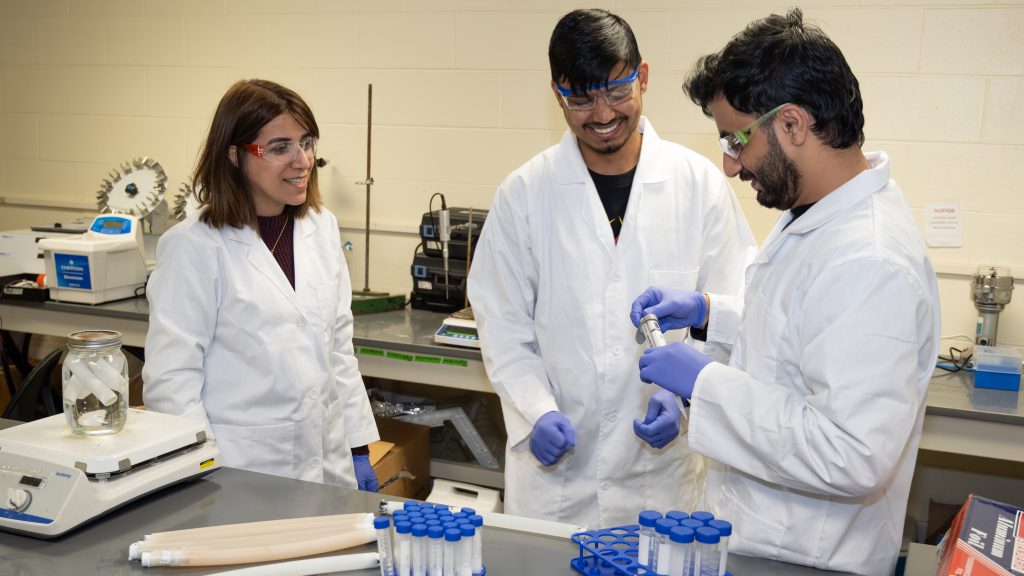
Working with graduate researchers Atif Bashir, Dibya Kanti Datta and Shima Ghoochani, Salehi began by looking at how disinfectants oxidize plastic pipes over time and how those pipes then interact with other chemicals in the water.
The researchers exposed PEX-A to a high-strength chlorine solution. This caused microscopic cracks to appear in the chemically degraded plastic. Next, they added lead, copper and zinc to water to create a controlled test solution and circulated it through multiple PEX‑A test loops.
They found that, under simulated drinking-water conditions, aged PEXA pipes accumulated more metals than new pipe: 87% of the lead they had added to the water, 97% of the copper and 64% of the zinc (compared to 30% for new).
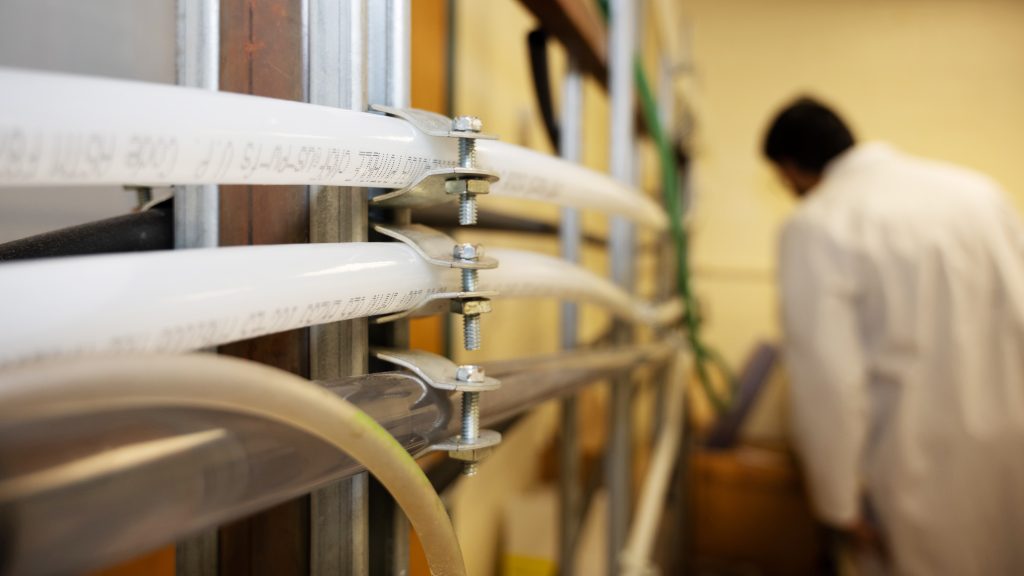
The study also found that alkalinity and pH levels affected how the plastic pipes accumulated and released metal, and that ordinary hot water temperatures can accelerate chlorine decay.
“We found a higher rate of chlorine decay for aged pipe compared to new pipe,” Salehi said. “For room temperature water supply, half-life of chlorine residuals [time required for half of the chlorine residuals present in supply water to decay] in new plastic pipes was 4.1 hours. That dropped to 1.5 hours for aged plastic pipes, promoting the chance of microbial growth.”
Salehi is currently working on a paper that looks at the sequestration, retention and transport of microplastics and nanoplastics in potable water pipes.
The PEX-A study was funded by a grant from the National Science Foundation and an Environmental Protection Agency assistance agreement with the Missouri Water Center.
The researchers benefited from the unique collaboration of two Mizzou Engineering centers: The Missouri Water Center provided analytical capability and access to faculty, and the Missouri Center for Transportation Innovation provided support for analytical instrumentation.
“Having these two centers and their expertise here in the College of Engineering is extremely valuable,” Salehi said. “It’s this kind of collaboration that allows us to develop practical solutions to real-world issues.”
Discover more ways Mizzou Engineers are building a more resilient world.