September 24, 2026
Congressional briefing highlights Mizzou’s growing role in quantum research, workforce development and national competitiveness.
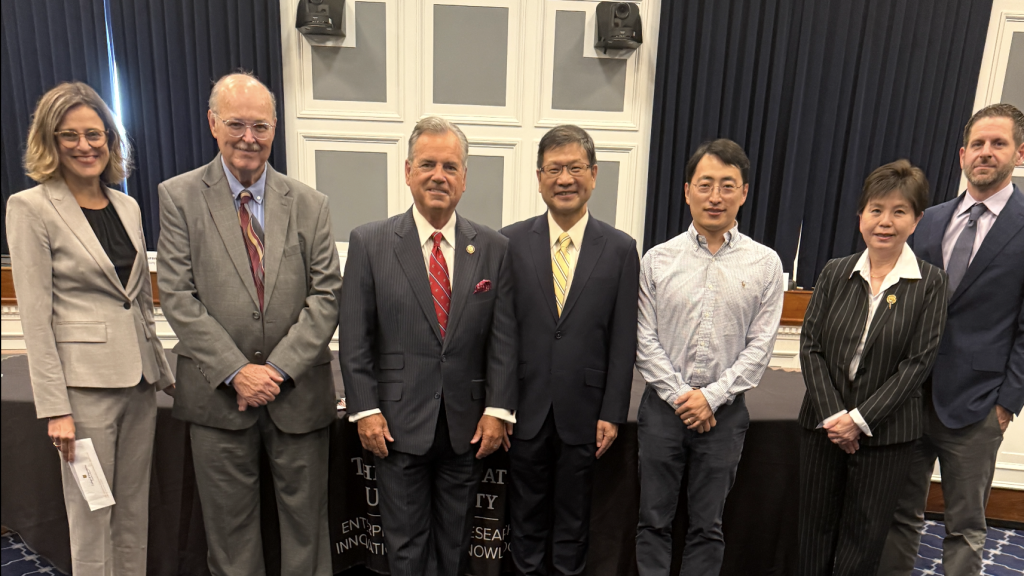
Mizzou Engineering faculty brought their expertise in quantum research and workforce development to policymakers on Capitol Hill in a recent congressional briefing on the future of quantum technology.
Held Sept. 16 in Washington, D.C., the briefing, titled Winning the Quantum Race, was organized by Stony Brook University and co-hosted by U.S. Reps. Mark Alford of Missouri and Nick LaLota of New York.
Participating institutions included the University of Missouri, Stony Brook University, The Ohio State University, Brookhaven National Laboratory and the U.S. Department of Energy Office of Science.
The event brought together leaders from academia, government and national laboratories to discuss how the United States can maintain its competitive edge in quantum science and technology.
For Mizzou Engineering, the briefing represented more than a chance to showcase research strengths and shape a national conversation about the scientific advances, workforce strategies and partnerships needed to secure America’s leadership in quantum technology.
“Public research universities like Mizzou play a key role in connecting discovery, education and federal policy to address emerging national priorities,” Mizzou Engineering Dean and Ketcham Professor Marisa Chrysochoou said. “Whether it’s quantum, artificial intelligence or energy, we’re prepared and eager to lend our expertise and help engineer a better world.”
During a panel on the science and applications of quantum technologies, Associate Professor Wenchao Ge emphasized the importance of sustained federal investment to help move quantum technologies from research laboratories into practical applications.
“Quantum information has showed up in quantum computing, sensing and communication — applications crucial to the U.S. national security, economics, and healthcare,” Ge said. “Federal investment will help create an ecosystem between academia and industry, which will develop the quantum workforce and drive innovation in quantum technology to realize its full potential.”
Another discussion focused on preparing people for careers in an emerging industry that will require far more than quantum physicists.
“We need to make our broader STEM workforce quantum-ready,” said Chi-Ren Shyu, professor and director of the MU Institute for Data Science and Informatics. “We can take our experts in agriculture, healthcare and biotechnology, logistics and supply chains, energy, geospatial intelligence, and national security and add quantum knowledge and capabilities to the expertise they already have.”
Shyu highlighted several Mizzou initiatives aimed at expanding participation in quantum science, including hands-on access to real quantum computers through the Quantum Innovation Center, the QLearning Buddies program and summer research opportunities.
Panelists also discussed the role midwestern universities can play in building regional quantum ecosystems. Shyu pointed to the potential of the Great Plains Network to connect universities and share opportunities beyond coastal technology hubs.
“By connecting institutions across the region, we can share expertise and infrastructure and build collaborative research and workforce programs,” he said. “Together, we can create a much larger quantum community than any one institution could build alone.”
CTA: Want to lead the charge in quantum, artificial intelligence, energy or other critical fields? Become a Mizzou Engineer!