February 16, 2026
Engineering students demonstrated creativity, problem-solving and teamwork in NSF-funded research projects that applied advanced technology to the human nervous system.
Mizzou Engineering has a rich history of academic excellence. Here, we prepare students to design, build and maintain the advanced infrastructure, technology and tools of the future.
Computer science students recently presented projects in a new course that was developed by a $500,000 National Science Foundation (NSF) grant awarded to Professor Satish Nair and Associate Professor Praveen Rao to train the next generation of engineers and neuroscientists in advanced cyberinfrastructure.
“Gaining experience with cutting-edge technology is part of the Missouri Method of learning by doing,” Nair said. “This hands-on learning prepares our students to advance the intensely data-intensive field of neuroscience research.”
Two of the three projects leveraged the power of artificial intelligence (AI). Senior Brandon Gomes noted the transformative — and disruptive — power of AI but said Mizzou Engineering students were eager to master it.
“Rather than merely using AI, I want to build it,” Gomes said. “Humans are persistence runners. You just have to keep going.”
Although his group chose not to use AI on their project, senior Krishna Rithwik Karra nonetheless said the growth of AI as a fundamental technology across every industry will create new career paths and expand existing ones.
“The current rise of AI mirrors the period when computers first entered the mainstream workforce,” he said. “Engineers who know when and how to integrate AI responsibly, especially in physical and biological systems, are becoming increasingly valuable.”
Rao echoed Karra’s confidence.
“The careers of the future rely heavily on creativity, problem-solving and innovation,” he said. “That’s precisely what we teach at Mizzou Engineering, preparing our graduates to increase productivity, solve complex problems and thrive in the future.”
Ajay Kumar and Vladimir Omelyusik, both PhD students in computer science, assisted students with state-of-the-art neuroscience pipelines and advanced cyberinfrastructure.
Dive deeper into the students’ research below.
Reasoner-Executor Latent Diffusion Model (R-E LDM)
Researchers: Brandon Gomes, Skylar Perry
Goal: Recreate observed image stimuli from observer’s EEG brainwave data.
Dataset: Mendeley EEG dataset with 32 subjects viewing four different images.
Method:
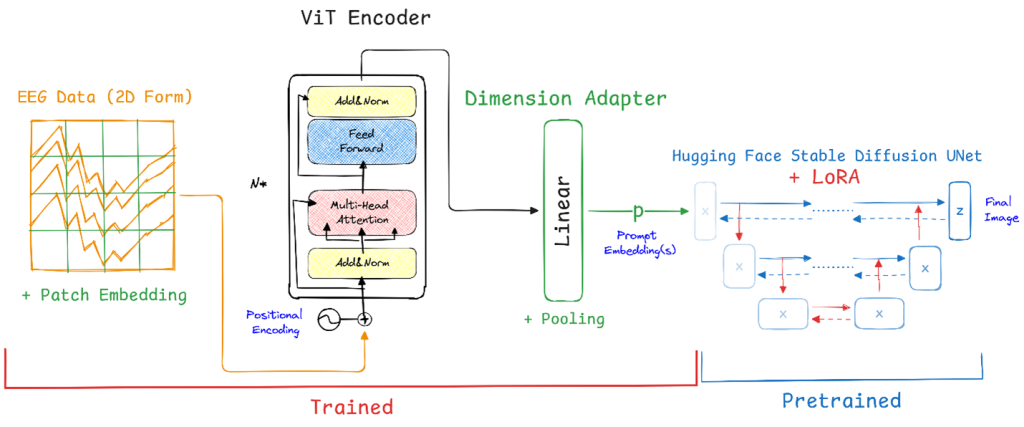
- EEG data was reshaped and normalized, then split into patches.
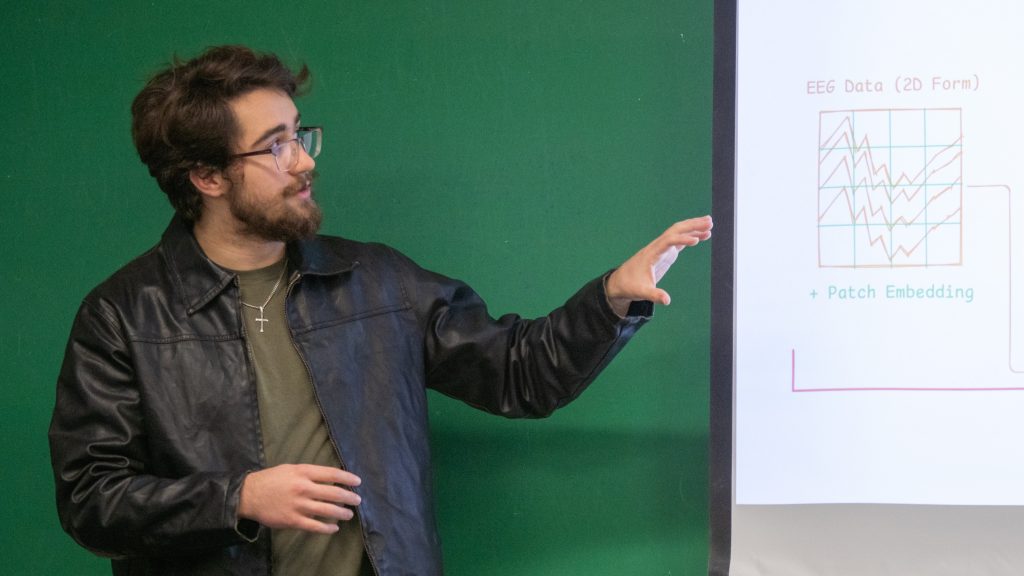
- Used an EEGVit encoder (a vision transformer) to project the EEG signal patches into contextualized token embeddings.
- The sequence of tokens is truncated and mapped into an image embedding space (via CLIP) in a format suitable as input to the Stable Diffusion model (PsygMind TinySD from Hugging Face).
- The diffusion model is fine-tuned using low-rank adaptation (LoRA) to train only attention layer subsets of the U-net (which the diffusion model is made of), minimizing resource use.
Challenges: Severe resource limitations on AWS and Fabric clusters; ended up overfitting on a single example to validate the pipeline.
Outcome: Proof-of-concept framework showing feasibility of translating EEG signals into image recreations.
Deep Prep Implementation
Researchers: Tyler Kalscheur, Christian Kiner, Samuel Mallet
Goal: Explore MRI-based depression diagnosis.
Datasets:
- Initial: MRI scans of chess players during gameplay.
- Later: OpenNeuro dataset with 72 subjects (52 with depression, 20 controls).
Method:
- Heavy preprocessing (chess dataset took ~20 hours).
- Ran jobs on Fabric with limited resources (12 cores, 16 GB RAM, RTX 6000 GPU).
Challenges: Resource allocation issues; final run on depression dataset took two days 16 hours but crashed before completion.
Outcome: Partial visualization of brain activity for depression patients; control group data was incomplete. Learned workflow and HPC resource management.
Modeling Neural Circuit of Lower Urinary Tract Goal: Simulate and monitor neural control of the lower urinary tract (LUT) in real time.
Researchers: Hunter Bushnell, Krishna Rithwik Karra, Daniel Sparks
Goal: Combine mechanistic neuroscience with modern cyberinfrastructure to make these systems easier to explore, visualize, and eventually translate into assistive technologies.
Method:
- Adapted an existing neural network model to run interactively.
- Simulated bladder pressure, volume, and neural firing rates.
- Micro:bit hardware served as a real-time interface for sensing, feedback and system interaction, reinforcing the need for predictable and explainable model behavior.
Applications: Assistive tech for patients lacking bladder sensation; potential integration with stimulation devices or predictive ML algorithms.
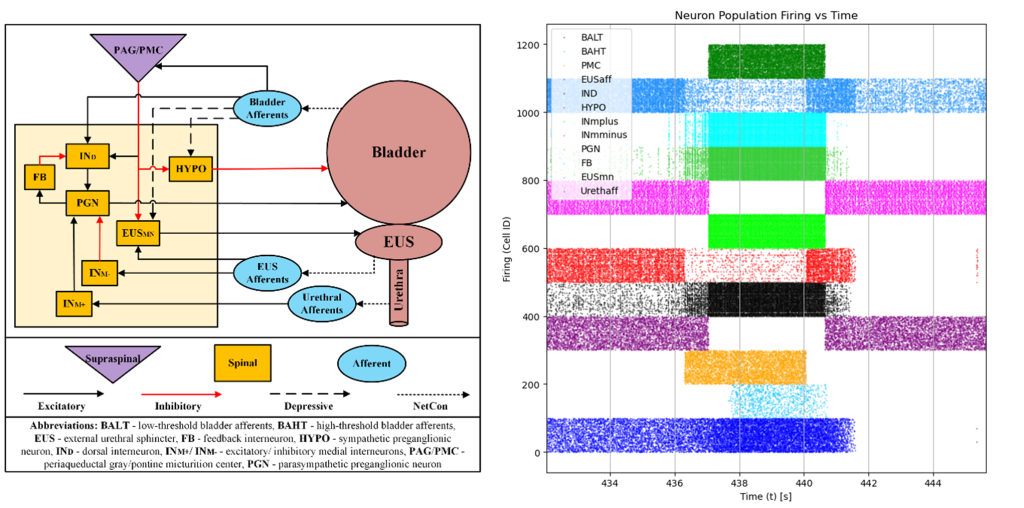
Challenges: Scaling the model for real-time performance required reducing complexity (10 cells per population vs. planned 10,000).
Future Vision: Use HPC clusters for full-scale simulations; develop UI for parameter tuning; integrate optogenetics or machine learning for predictive control.
Want to tackle the challenges of tomorrow? Choose Mizzou Engineering!