Developing algorithms, data systems and computing infrastructure, from mathematical foundations to systems in operation.
Our faculty develop machine learning methods, data and decision systems, secure networks, quantum information processing and robotics. Research covers model accuracy and interpretability, optimization for scheduling and logistics, network and device security, trapped-ion quantum platforms, and autonomy in physical systems. Much of the work depends on research computing infrastructure the college builds and operates for the UM System.
Mizzou AERI anchors much of the work. The initiative is the university’s hub for interdisciplinary and responsible artificial intelligence, supported jointly with the College of Arts and Science and the Division of Information Technology, and spans foundational AI, applied AI, testbeds and workforce development. CERI develops research computing and cyberinfrastructure for the UM System, the Mizzou Quantum Innovation Center provides access to IBM’s quantum systems, and the Center for Geospatial Intelligence works in geospatial analysis and imagery exploitation. Current sponsors include the National Science Foundation, the National Institutes of Health, the National Security Agency and defense research agencies. Faculty also collaborate with universities and companies across the country.
Faculty
AI and Machine Learning
Learning algorithms, model architectures and methods for accuracy, interpretability and reliability in deployment.
Derek T. Anderson
Professor
Filiz Bunyak Ersoy
Assistant Professor
Satish S. Nair
Professor
Yi Shang
Professor, Robert H. Buescher Faculty Fellow
Xiu-Feng “Henry” Wan
Curators’ Distinguished Professor
Matthias J. Young
Associate Professor
Jianlin Cheng
Curators’ Distinguished Professor
Xiaolei Huang
Associate Professor
Diana Gil Pagés
Associate Professor
Changyu Sun
Assistant Professor
Zheng Yan
Associate Professor, Cramer W. LaPierre Professor
Curt Davis
Professor
Jordan Malof
Assistant Professor
Kannappan Palaniappan
Associate Professor
Jeffrey Uhlmann
Associate Professor
Gary Yao
Professor
Cybersecurity
Network, device and software security, intrusion detection, and formal methods for verifying system behavior.
Prasad Calyam
Curators’ Distinguished Professor, Associate Dean for Research
Rohit Chadha
Associate Professor
Khaza Anuarul Hoque
Associate Professor
Data Science, Analytics and Operations Research
Analysis of large and heterogeneous data, and optimization for scheduling, logistics and operational decisions.
Noel Aloysius
Associate Professor
Jung Hyup Kim
Associate Professor
James Noble
Professor and Chair, P.E.
Chi-Ren Shyu
Paul K. and Dianne Schumaker Professor
Sean Goggins
Professor
Tanu Malik
Associate Professor
Suchi Rajendran
Associate Professor
Sharan Srinivas
Associate Professor
Toni Kazic
Associate Professor
Hyeong Suk Na
Assistant Professor
Praveen Rao
Professor
Petros Valettas
Assistant Professor
Quantum Information and Computing
Quantum information processing on trapped-ion and photonic platforms, quantum machine learning, and the security of shared quantum hardware.
Filiz Bunyak Ersoy
Assistant Professor
Robotics
Perception, control and autonomy in machines operating in physical environments.
Anchoring Centers
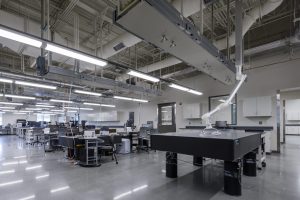
Mizzou AERI
AI Education, Research and Infrastructure
The university’s hub for interdisciplinary and responsible artificial intelligence, supported jointly by engineering, the College of Arts and Science, and the Division of Information Technology. Work spans foundational and applied AI, AI-ready testbeds and workforce development.
CERI
Cyber Education, Research and Infrastructure
A multi-university center for cyber, artificial intelligence and data analytics. CERI operates a research computing program and develops cyberinfrastructure for the UM System and peer institutions.

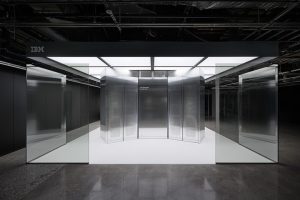
Mizzou Quantum Innovation Center
The 40th IBM Quantum Innovation Center worldwide and the only one in the region, giving researchers here and at partner institutions access to IBM’s quantum systems and software. The center draws faculty from engineering, the College of Arts and Science and MU Information Technology, and its members have produced twenty-five publications since 2024, with more under review. Work spans quantum computing, quantum physics, quantum methods for artificial intelligence, and applications in the life sciences and energy.
Center for Geospatial Intelligence (CGI)
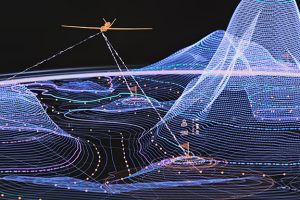
Research, development and training in geospatial analysis, imagery exploitation and the associated computational methods.
Highlights

A federal pipeline for cybersecurity talent
Chi-Ren Shyu – Active through 2027
$3.64M | National Science Foundation
This NSF-funded program prepares graduate students for cybersecurity careers in federal service. Security coursework and research are paired with placement in participating federal agencies.
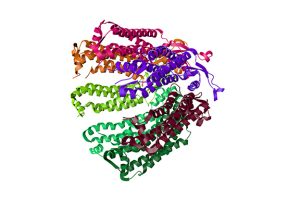
Reconstructing protein complexes
Jianlin Cheng – Active through 2030
$2.29M | National Institutes of Health
This project develops artificial intelligence methods that reconstruct protein complex structures from cryo-electron microscopy data. Complexes, rather than single chains, carry out most protein function and are substantially harder to resolve.
Physics-informed machine learning for materials design
Derek T. Anderson – Active through 2030
$1.72M | U.S. Army Engineer Research and Development Center
This research is focused on physics-informed machine learning for the design, discovery, and characterization of materials with specified electromagnetic and optical signature properties. The approach uses artificial intelligence to effectively narrow a search space too large to cover experimentally.
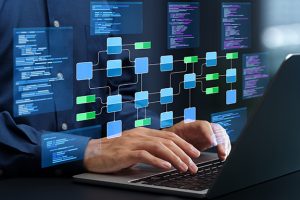
Making computational results reproductible
Tanu Malik – Active through 2028
$977K | National Science Foundation
This project builds frameworks that convert exploratory computational notebooks into reproducible workflows and back again. An analysis then remains executable as it moves between researchers, machines and archives.

Streaming clinical care into the home
Prasad Calyam – Active through 2028
$720K | National Science Foundation
This Industry-University Cooperative Research Center addresses the delivery of healthcare outside clinical settings. Its research covers the networking, data handling and security required to stream clinical-grade information from a patient’s home.

Distributed training for large language models
Praveen Rao – Active through 2027
$500K | National Science Foundation
This project uses FABRIC, the national programmable network testbed, to make distributed training of large language models practical. The work targets researchers whose institutions cannot host the computing capacity such training normally requires.
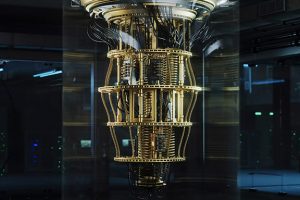
Quantum computing with trapped ions
Wenchao Ge – CAREER Award, through 2030
$500K | National Science Foundation
This CAREER award develops photonic control and measurement methods for trapped-ion quantum information processing. Trapped ions are held in place by electromagnetic fields and manipulated with light, and remain among the leading platforms for quantum computing.
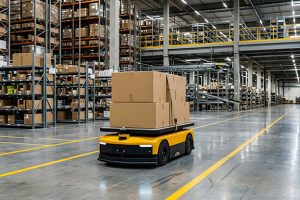
Coordinating people and mobile robots on the floor
Sharan Srinivas – Active through 2028
$450K | National Science Foundation
This project optimizes the coordination of people and mobile robots on manufacturing and service floors. Students work alongside international research partners addressing the same problem.

Optimizing airport passenger screening
Hyeong Suk Na – Active through 2027
$394K | U.S. Department of Homeland Security, through Arizona State University
This project combines stochastic optimization with artificial intelligence to improve advanced imaging technology screening at airport checkpoints. The work treats throughput and detection performance together rather than trading one against the other.